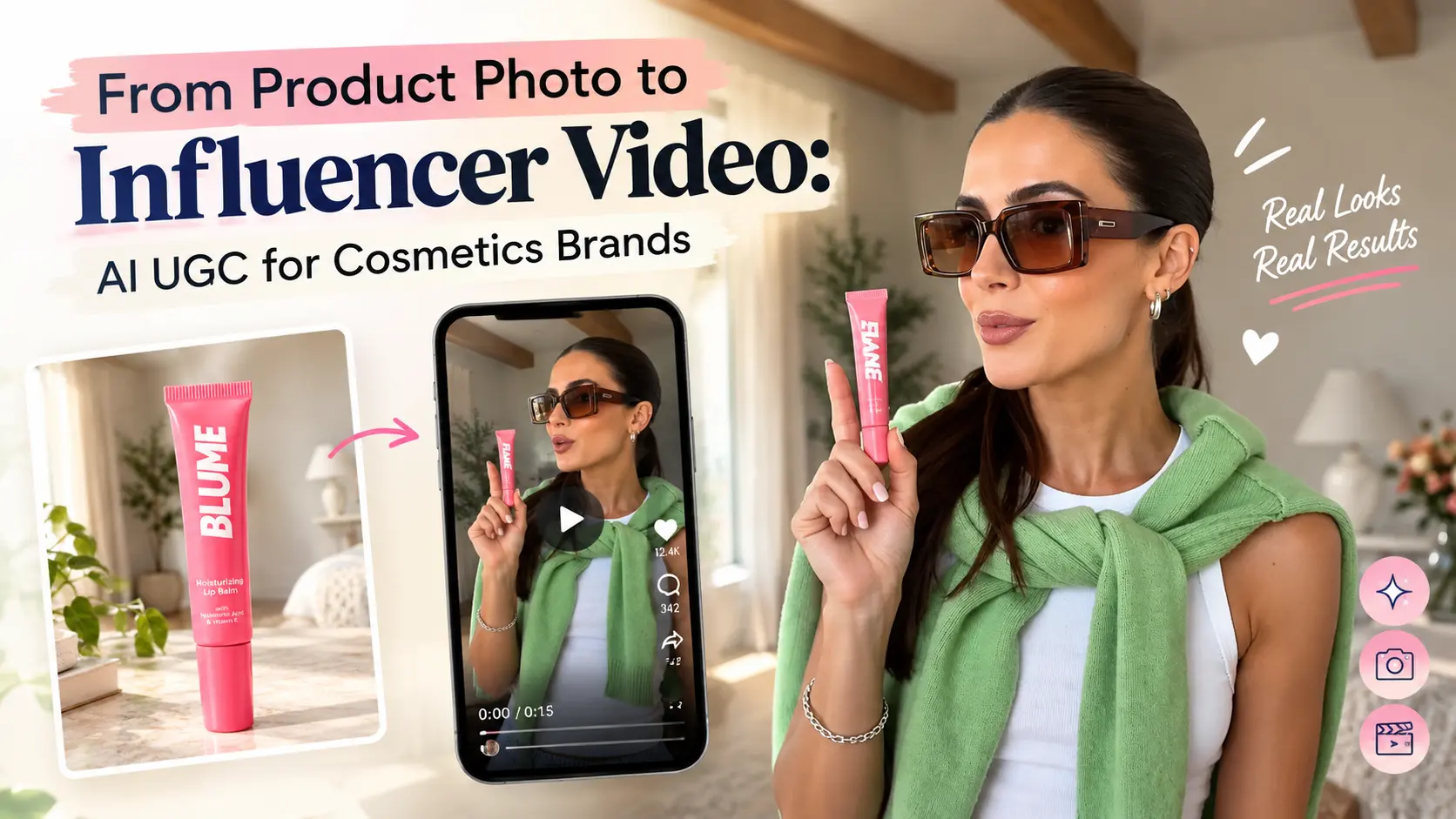
And this is where it ends up: a 10 second influencer-style video. A creator in sunglasses and a green sweater holds the tube up, applies it to her lips, smiles, and holds it back out to the camera. No influencer was hired. No product was shipped. The creator is AI, and the whole thing took a few minutes and about $2.
Cosmetics is the category where this matters most. Beauty buyers want to see the product on a person before they buy, and they want that person to look like someone they follow, not a model in a studio. For years that meant paying influencers. Now it means a product photo and a prompt.
This guide walks through the full workflow for cosmetics brands: what the product photo needs, how to build a creator that fits your brand, the shots every beauty ad has to include, and the exact prompt behind the lip balm video.
Why cosmetics brands need UGC more than a product shot
A product photo tells the buyer what it is. It does not tell her what it looks like on. For lip balm, lipstick, blush, gloss, foundation, the whole purchase decision is "will this suit me", and a tube on a table cannot answer that.
Influencer UGC answers it. A person applies the product on camera and the buyer compares the result to her own face. The problem has always been cost and speed. A beauty creator charges $200 to $800 for one video, needs the product shipped, and takes one to three weeks.
AI UGC flips that. The same product photo becomes a video with a creator who matches your buyer, and a second shade is a second photo and the same prompt.
Step 1: Get the product photo right
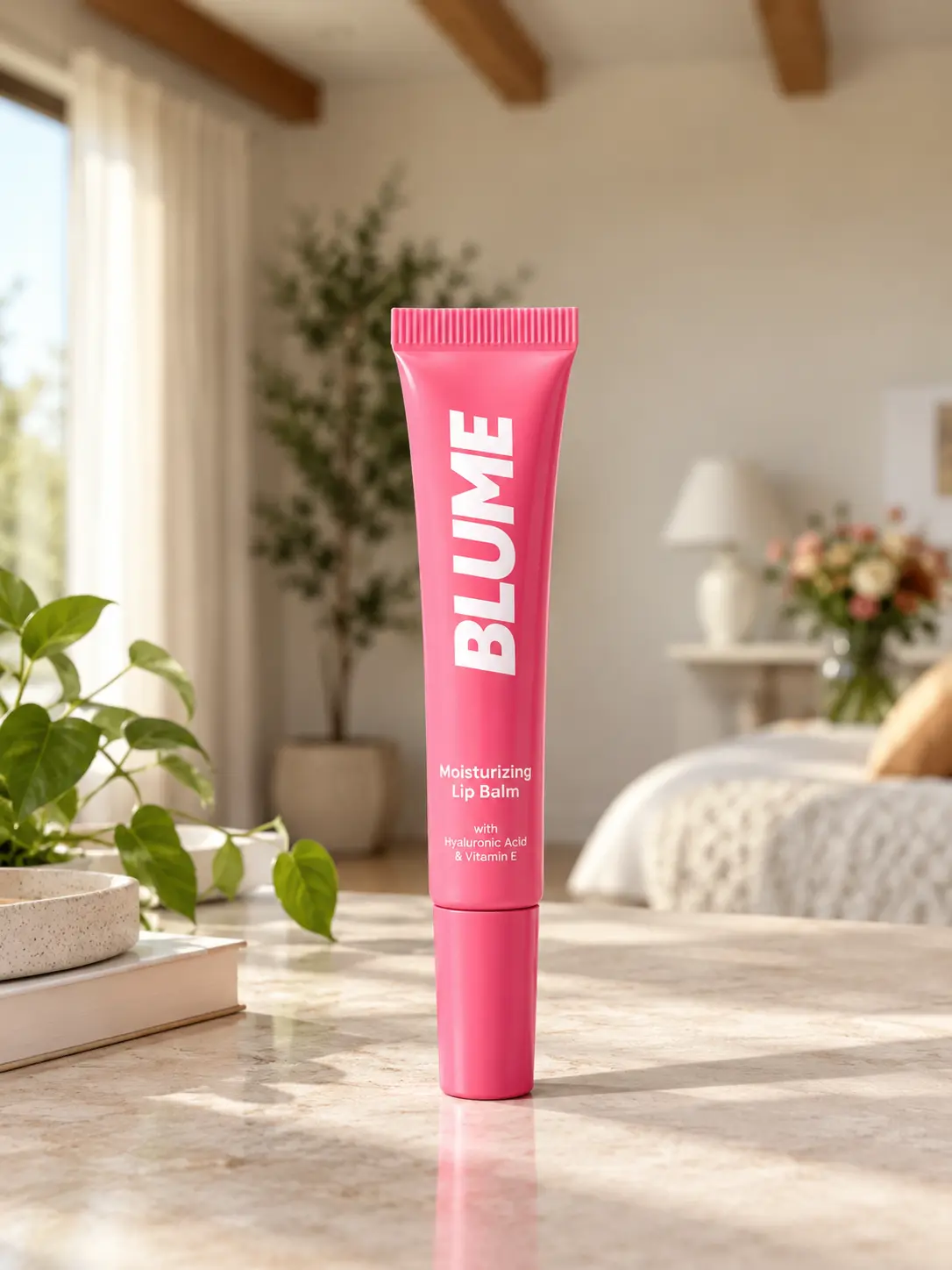
Everything downstream depends on this image. The lip balm photo above works because:
The label is readable: Brand name big, product type under it, key ingredients visible. The model copies what it can read.
The product stands alone: No hands, no props touching it, nothing to confuse what the product is.
The setting matches the ad: Warm living room, wooden beams, plant, flowers, soft daylight. When the product photo and the creator's room share the same light and colours, the video model has less to invent and the product looks like it belongs in her hand.
The colour is true: Pink tube, pink cap, nothing colour-cast by the light. For cosmetics the shade is the product, so the photo has to show it accurately.
A white-background shot works too, but a photo in a real setting gives a more believable video.
Step 2: Build a creator who fits the brand
Beauty buyers follow creators who look like the aspirational version of themselves. That is the brief.
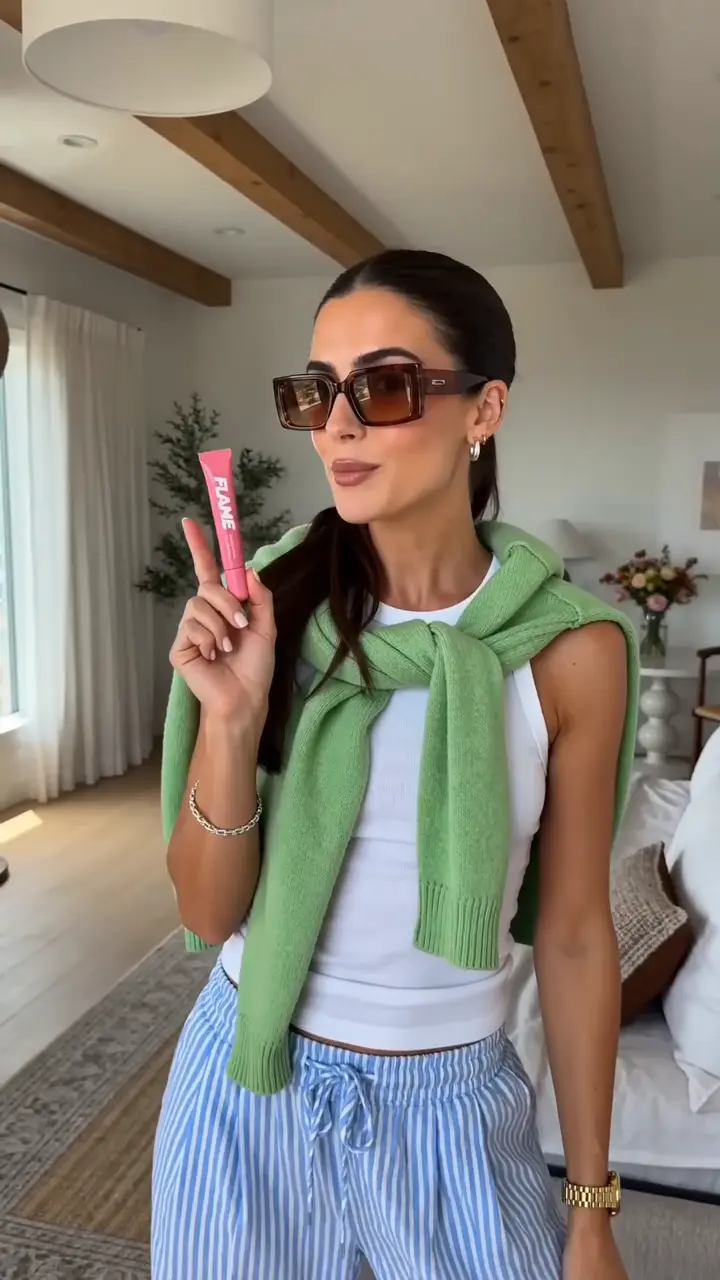
Open the UGC character generator and describe her, or pick a ready creator from the Community. For the lip balm, the creator was built to match a lifestyle beauty brand: late 20s, dark hair pulled back, brown rectangular sunglasses, white tank top, green sweater tied over the shoulders, striped blue trousers, gold watch and bracelet. Polished but off-duty.
The character prompt used:
Woman in her late 20s, dark brown hair slicked back into a low
ponytail, brown rectangular sunglasses, small gold hoop earrings,
natural skin with a light glow and visible texture, soft pink lips,
small confident smile. White ribbed tank top, light green knit
sweater tied over the shoulders, blue and white striped drawstring
trousers, thin gold bracelet and gold watch. Standing in a bright
modern living room with wooden ceiling beams, sheer white curtains,
an olive tree and a vase of flowers behind her. Soft daylight.
Portrait, 9:16.
No heavy retouching, no plastic skin, no perfect symmetry, no glossy
filter, not a 3D render.
Two notes for cosmetics specifically:
Keep her lips natural in the character image. If the character already has a bold lip colour, the lip balm swatch will not read. Build her with a soft natural lip so the product shows a change.
Sunglasses are a choice. They give the off-duty influencer look and keep attention on the lips. For eye products, leave them off.
Save the creator image. Every video and still for this brand starts from it, so the face stays the same across every shade.
Step 3: The shots every cosmetics UGC ad needs
The hold
The ad opens here. Creator close to the lens, tube held up beside her face with the label to camera. The tube is small, so it has to be close to her face and the label has to be sharp.
The swatch
The product goes on. For lip balm, she applies it straight from the tube to her lips. For lipstick, a swipe. For blush, a tap on the cheek. For foundation, a dot and a blend. Two to three seconds, slightly imperfect, no cut-away.
The result
She closes her lips, smiles, looks at the camera. The viewer sees the shade on a real face in real light. In the lip balm video this is the smile at the seven second mark.
The hold again
She brings the tube back to the camera and the ad ends. The product is the last thing seen. No pitch, no "link in bio" spoken. The reaction was the CTA.
Hooks that work for beauty
The first second decides whether the swatch gets seen. Use one, spoken, with the tube already up.
The shade hook. "This is the pink I keep getting asked about."
The texture hook. "It's a balm but it looks like a gloss. Watch."
The everyday hook. "The one lip product I actually reapplied."
The ingredient hook. "Hyaluronic acid in a lip balm. I did not know I needed this."
The dupe hook. "Cheaper than the one everyone has and it lasts longer."
The "finally" hook. "Finally a tinted balm that does not dry my lips out."
Pick one. Ten seconds cannot carry shade, texture, ingredients and price.
The 10 second script
Cosmetics ads run short. The swatch is the content. Structure:
0 to 2s: hook. Tube up, one line.
2 to 5s: apply. The swatch, on camera, no cut.
5 to 8s: result. Lips closed, smile, look at camera.
8 to 10s: hold. Tube back to lens. End.
A script you can copy for any lip product:
This is the pink I keep getting asked about.
It's a balm, so it's hydrating, but look at the colour.
That's one layer.
Okay. That's all I'm wearing today.
No brand name spoken. The label on the tube does that job in the hold shot.
Step 4: Make the video
Open the UGC ad generator. Upload the creator as @image1 and the product photo as @image2. Describe the ad in one box. The prompt used for the lip balm video:
@image1 stands in her bright living room, phone camera at eye level,
slightly off centre. She holds @image2 up beside her face with the
label facing the lens and says "this is the pink I keep getting asked
about". She uncaps the tube and applies the balm directly to her lips
in one slow pass, lips slightly parted. She presses her lips together,
smiles at the camera, and says "that's one layer". She holds the tube
back out toward the lens and the video ends.
Casual, relaxed delivery with small pauses, natural hand movement.
Soft daylight from the window, wooden beams and olive tree out of
focus behind her. Natural skin texture, no beauty smoothing, no
studio lighting, no fast cuts, product label sharp in every frame.
Settings: 9:16, 720P, 10s, sound effect on. Run two or three attempts and keep the one where the swatch looks like it actually went on. If the label blurs during the hold, add "label sharp and readable" to the prompt and retry.
Step 5: Scale it across shades and formats
One creator, one prompt, every product in the line.
New shade. Swap @image2 for the next product photo. Same creator, same script, new colour. Twelve shades in an afternoon.
Stills for the product page. Use the UGC image generator with the creator image to make the hold shot and the result shot as stills. Put them next to the add-to-cart button.
Organic content between ads. Use the UGC video generator for "get ready with me" clips, a shelf tour, a morning routine, so the same face shows up in the feed and not only in ads.
Three hooks, one product. Same video, three opening lines. Let the platform pick the winner.
Cost per finished video is about $2 across three attempts. A beauty creator for one video is $200 to $800, plus product, plus two weeks, plus more for usage rights.
Turn your product photo into an influencer video on Templix
Mistakes that make cosmetics UGC look fake
A bad product photo. Blurry label, colour cast, props touching the tube. Fix the photo first; everything else inherits it.
No swatch. Holding a lipstick is not a lipstick ad. It has to go on.
Glass skin. Beauty buyers are experts at spotting retouching. Ask for visible texture every time.
Studio light. Flat light hides the shade. Window light shows it.
A full face of makeup already. Build the creator with a natural face so the swatch reads.
Listing benefits. One hook, one shade, one swatch. The caption can carry the rest.
A spoken CTA. The hold at the end is the CTA. "Link in bio" out loud kills the share.
Frequently Ask Questions
Can AI turn a product photo into an influencer video?
Yes. Upload the product photo and a creator image, describe what she says and does with the product, and the ad generator produces a short talking video with the product in her hand. The lip balm video in this guide was made from the single photo at the top.
What makes a good product photo for AI UGC?
A readable label, the product standing alone with nothing touching it, true colour, and a setting that matches where the creator will be filmed. A white-background shot works, but a photo in a real room gives a more believable video.
How long should a cosmetics UGC ad be?
Ten to fifteen seconds. Hook, swatch, result, hold. The swatch is the content; anything longer is a tutorial.
How do I show the same creator across different shades?
Save one creator image and use it as @image1 for every video. Change only the product photo. Never rebuild the creator from text, or the face will drift between shades.
How much does an AI UGC video cost for a beauty brand?
About $2 per finished video across two or three attempts, with no shipping, no usage-rights fees and no waiting. A human beauty creator charges $200 to $800 per video plus product, with one to three weeks of turnaround.

Hamza Tariq
Digital advertising specialist focused on AI-powered marketing, paid campaigns, audience targeting, ad optimization, performance analytics, and data-driven growth strategies.