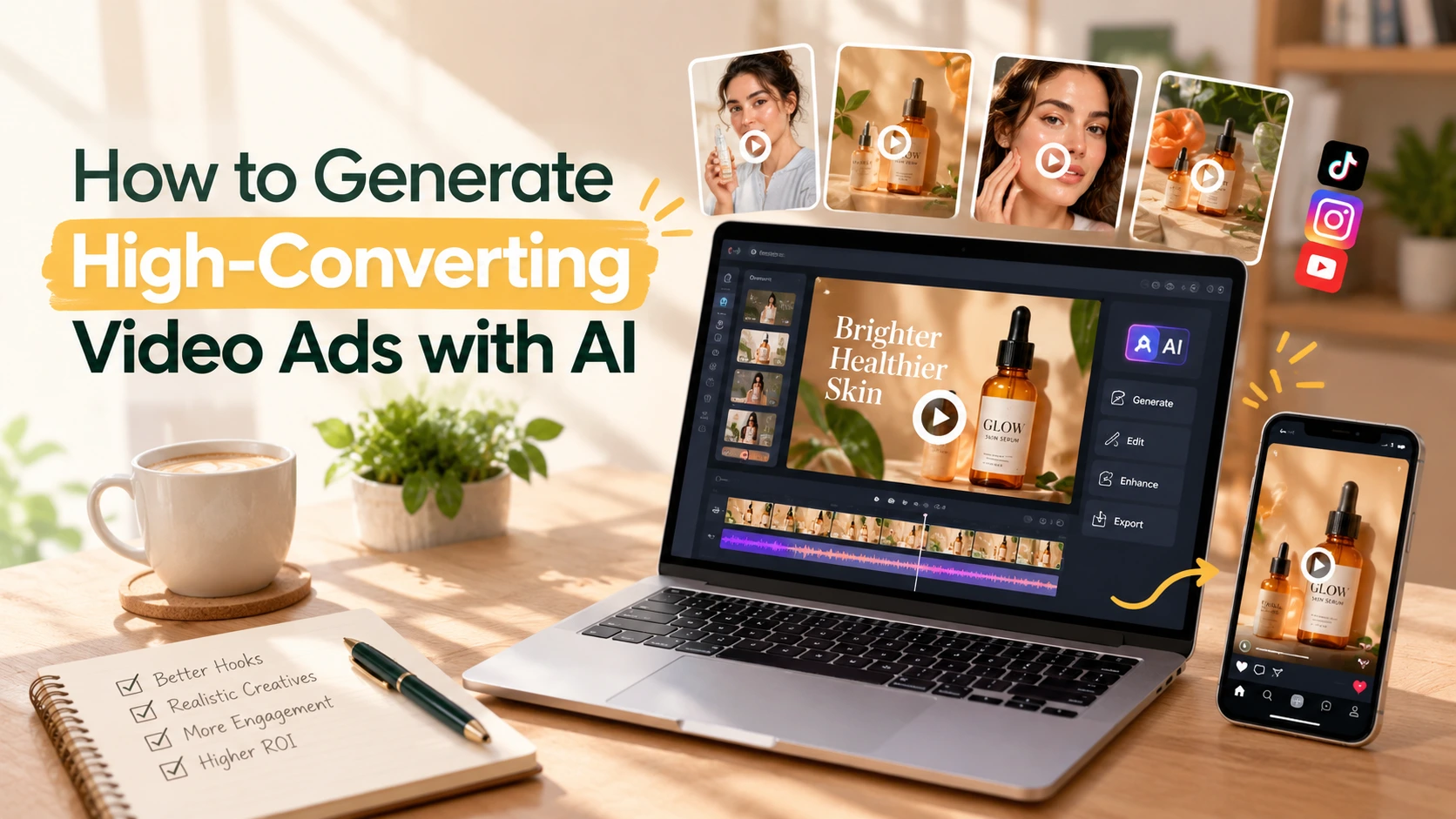
High-converting video ads do not come from a single viral generation that happens to work. They come from a disciplined workflow built around testing many hook variations against the same offer, measuring the specific metrics that matter for paid campaigns, and scaling the variations that actually produce results in real ad platform data. AI tools have reshaped the specific production step inside this workflow, but the surrounding discipline that determines whether the finished creative actually converts remains the same regardless of how the content gets produced. Teams running paid campaigns at volume need a workflow that treats AI generation as the content production engine while keeping the measurement, iteration, and scaling discipline that paid campaign work actually requires.
This guide covers the complete workflow for producing high-converting video ads on Templix, which includes Ad Studio for polished brand ad creative, the UGC Ad Generator for creator-style sponsored content, and the broader video model catalog for custom ad direction. Every step below includes the specific Templix tool that handles that production stage, so you reach for the right tool from the start rather than trying to force every ad through a single workflow.
Steps to Create a High-Converting Video Ad With AI
Six specific steps cover the complete workflow from research through scaling. Skipping any step typically produces ads that look fine individually but fail to convert at the volume paid campaigns need to be profitable.
Step 1: Research the Hook Before Writing Anything
Review competitor ads running in your category (through Meta Ads Library, TikTok Creative Center, or similar tools) alongside your own customer reviews and support ticket data. The specific goal of this research step is identifying a specific pain point your customers describe in their own words, which becomes the raw material for the hook that opens your ad.
Record the competitor claims you see in their creative, specifically noting claims your product cannot back up truthfully. Avoiding claims you cannot support protects the ad account from policy violations and protects the brand from customer trust issues on paid campaigns. The hook that opens your ad has to be honest to your product's actual capabilities while still articulating the specific pain point in language customers recognise as their own experience.
Step 2: Pick One Hook and One Offer
Successful ad creative pairs one specific hook (the opening that captures attention in the first 1 to 2 seconds) with one specific offer (the specific thing you want the viewer to do, including a reason to do it now). Ads that try to carry multiple hooks or multiple offers in the same creative dilute both and produce measurably weaker conversion rates than focused single-hook single-offer creative.
The hook can either open on the problem your product solves (customer-recognisable pain point as the first visual beat) or on the product itself demonstrating the specific capability that solves the problem (feature-led opening). Different hook structures work better for different product categories and audiences, which is why the testing step covered below produces measurably better output than committing to one hook structure across every campaign.
For creators focused specifically on hook structure optimization, our best ad hooks guide covers the specific opening patterns that consistently outperform generic hooks across product, service, and lifestyle ad campaigns.
Step 3: Provide a Product Reference
The AI tool generating your ad creative needs source material that establishes what your actual product looks like. For physical products, upload the clearest existing product photo you have available. For digital products, prepare a visual reference showing the product interface, packaging, or whatever visual element will carry the product identification in the generated ad.
For creators running Templix Ad Studio specifically, the dedicated ad creative workflow carries uploaded product references into every generated variation automatically, which produces measurably more consistent product rendering across the ad set than regenerating from scratch per variation. For creator-style UGC ad content, the Templix UGC Ad Generator handles the same product reference approach specifically for the authentic creator aesthetic that converts on short-form social platforms.
Always check generated product details against your real product listing before running the ad live. Generated creative occasionally renders packaging text, colour variations, or product proportions slightly differently from the actual product, and running creative that misrepresents the product produces trust problems alongside potential ad platform compliance issues.
Step 4: Pick the Visual Style That Fits the Offer
Four distinct visual style directions cover most high-converting ad creative, and matching the style to the offer type produces measurably stronger output than defaulting to one style across every ad.
Product-led demonstration ads show the product solving the problem directly, with the product itself as the hero of the visual. Templix Ad Studio handles this direction particularly well through polished product-focused creative generation.
UGC-style authentic creator ads show the product in the hands of someone who reads as a real customer rather than a brand creative, which fits channels like TikTok and Instagram Reels where authentic UGC often outperforms polished brand creative at the hook level. The Templix UGC Ad Generator is purpose-built for this direction.
Avatar-led spokesperson ads show a digital presenter delivering the ad message directly to camera, which fits educational products, explainer content, and categories where expert positioning drives conversion.
Cinematic lifestyle ads place the product inside aspirational lifestyle contexts rather than demonstrating the product directly, which fits lifestyle brands, hospitality, premium consumer goods, and categories where brand aspiration drives conversion more than feature demonstration.
For brand teams building strict visual consistency across campaign assets regardless of the specific style direction chosen, our branded marketing images guide covers the 5-element brand framework that holds visual direction stable across the full ad creative library.
Step 5: Prepare for Each Platform Placement
Different ad platforms require different format specifications, and generating creative at the wrong aspect ratio for the intended placement wastes the entire generation. Meta Stories and Reels, Instagram Feed, TikTok, YouTube Shorts, and LinkedIn Video all have specific format requirements that need to be set at generation time rather than cropped from a single master version afterward.
For each ad set, generate the specific format variations needed:
9:16 vertical for Stories, Reels, TikTok, and Shorts placements
1:1 square for Instagram Feed and LinkedIn Video
16:9 horizontal for YouTube in-stream and Facebook video placements
4:5 vertical for Instagram Feed vertical variations
Add readable captions to every ad creative because the majority of social video gets watched without sound initially. Captions that carry the hook and the offer in readable text ensure the ad still converts for viewers who do not turn sound on at any point during the view.
End every ad with a specific call to action that tells the viewer exactly what to do next. Generic CTAs ("Learn more", "Visit site") convert measurably worse than specific CTAs tied to the specific offer ("Get 20% off this week", "Download the free guide", "Book your consultation"). The specific CTA language carries meaningful conversion weight independent of the rest of the creative.
Step 6: Test Variations Systematically
High-converting ad creative emerges from testing hook variations against the same offer and the same visual direction, not from testing many different offers and visuals at the same time. The core testing discipline is changing only one variable between variations so the test results actually reveal what caused the performance difference.
Produce 4 to 8 hook variations of the same core ad, keeping the offer, visual style, product reference, and CTA constant across every variation. Vary only the hook that opens the first 2 seconds. Launch the variations through your ad platform (Meta, TikTok, Google), wait for statistically meaningful data to accumulate per variation, and compare the specific metrics that matter: CTR shows interest at the hook, conversion rate shows whether that interest translates to action, CPA shows cost per converted customer, and ROAS shows the actual return on advertising spend.
A hook that raises CTR while lowering conversion rate is specifically a mismatch problem (the hook attracts the wrong audience). A hook that raises both CTR and conversion rate is the specific winner you scale budget toward. Reading these metrics in sequence prevents the common mistake of scaling creative based on CTR alone, which can produce high clicks with low actual conversions and poor return on spend.
Why First-Seconds Hooks and Vertical Format Are Starting Points
The common advice that "hooks matter in the first 3 seconds" and "vertical format outperforms landscape on social" is directionally true but incomplete as the whole optimisation story. A strong hook that opens on the right pain point in the first 2 seconds is necessary for high conversion, but a strong hook combined with the wrong offer, the wrong visual style, the wrong CTA, or inadequate testing discipline still produces weak conversion overall.
Think of the first-seconds hook and vertical format as table stakes rather than performance drivers. Every competing ad in your category is also optimising for hook strength and vertical delivery, which means these elements are necessary for competing but not sufficient for winning. The actual conversion lift comes from the specific hook-offer-visual-CTA combination that fits your product and audience, discovered through the systematic testing covered in Step 6 above.
Worked Example: Turning One Product Photo Into Tested Ad Variations
Consider a travel coffee mug with a leak-proof lid as the product. The offer is a 20% launch discount for the first 500 customers. The product reference is one clean product photo on a white background.
Hook variation 1 (problem-led): "Coffee stains on your shirt again?" with the mug visible in the opening frame leaking in a competitor product, cutting to the Templix-generated mug staying leak-proof.
Hook variation 2 (feature-led): "Watch this lid lock in one motion" with a close-up demonstration of the specific lock mechanism as the opening frame.
Hook variation 3 (lifestyle-led): "Morning commute without the mess" opening on a professional carrying the mug through a busy subway with other commuters spilling their coffee.
Hook variation 4 (social proof led): "Why 10,000 commuters switched" with brief testimonial-style framing in the opening before showing the product.
Every other element across the four variations stays identical: the same offer, the same product reference, the same visual style direction, the same CTA, the same 9:16 aspect ratio. Launch all four through the ad platform, wait for statistically meaningful data, and compare performance across CTR, conversion rate, CPA, and ROAS before scaling budget toward the specific hook variation that produced the strongest conversion economics.
For creators evaluating broader AI video platforms specifically on pricing across different production profiles, our best affordable AI video generators guide covers 12 leading platforms with real cost comparison across solo creator budgets through enterprise-scale production.
Platform Formats, Captions, and CTA Checklist
Before launching any ad creative, verify every item on the specific checklist below. Missing any item typically produces weaker conversion than fixing the gap would require.
Correct aspect ratio for the placement: 9:16 for Stories/Reels/TikTok/Shorts, 1:1 for Feed/LinkedIn, 16:9 for YouTube in-stream, 4:5 for Instagram Feed vertical.
Readable captions throughout: The hook and the offer both appear as readable text so viewers watching without sound still get the full message.
Hook appears in the first 2 seconds: No slow intro, no logo splash, no setup time before the hook lands.
Specific CTA at the end: Named action tied to the specific offer rather than generic "learn more" language.
Product rendered correctly: Generated product matches your real product listing on colours, packaging text, and proportions.
Honest claims only: Every claim in the ad creative is something your product actually delivers, with no competitor-style claims you cannot back up.
Platform compliance verified: Each major ad platform has specific policy restrictions worth reviewing before launch.
Measuring and Scaling: What to Check Before You Spend More
Scaling an ad set to higher budget before verifying the creative actually converts at profitable economics is the single most common mistake in paid campaign work. Four specific checks determine whether a winning variation is ready to scale.
Verify tracking is working correctly: Ad platform conversion tracking occasionally reports inflated or missing conversions due to pixel setup issues, iOS tracking changes, or ad blocker effects. Before trusting any variation's performance data, cross-check the ad platform's conversion count against your own sales data to confirm the numbers actually match reality.
Wait for statistically meaningful data per variation: Conversion rate differences on small sample sizes commonly reverse once more data accumulates, which means scaling budget toward variations that appear to be winning on 10 or 20 conversions typically produces worse results than waiting for 50 to 100 conversions per variation before deciding.
Read conversion economics, not just CTR: A variation with high CTR and poor conversion rate loses money at scale even though the CTR looks promising. The specific metric that determines whether scaling the ad produces profit is ROAS (return on ad spend), which combines CTR, conversion rate, and average order value into one number that directly reflects campaign profitability.
Scale gradually and keep monitoring: Doubling budget on a winning variation rarely produces linear doubling of conversions, because the ad platform algorithm adjusts how it finds an audience at higher spend levels. Scaling in 20 to 30 percent increments while continuing to monitor conversion economics prevents the common mistake of scaling fast and watching the economics deteriorate before you catch it.
Choosing the Right Templix Tool for Each Part of the Workflow
Four Templix products cover different parts of the high-converting ad video workflow directly.
Templix Ad Studio handles polished product-focused and brand-focused ad creative suited to Meta, Google Display, and other channels where high-production visual quality drives conversion. Ad Studio is the right default choice for product-led ad creative, benefit-led variations, and polished brand ad content at scale.
Templix UGC Ad Generator handles UGC-style ad content that reads as authentic creator content rather than polished brand creative. This fits TikTok, Instagram Reels, and other short-form channels where authentic UGC aesthetic consistently outperforms polished brand creative at the hook level on cold-audience ads.
Templix UGC Video Generator covers broader creator-style short-form video content including organic social content alongside paid ad creative. For creators producing both organic UGC and sponsored UGC-style ads from the same workflow, the UGC Video Generator handles both production needs.
Templix UGC Character Generator locks the recurring brand face identity for campaigns featuring a consistent spokesperson or brand character across many ad variations. Combined with Ad Studio or the UGC Ad Generator, the character consistency carries across every variation in the ad set.
For creators who want to work directly with Templix's broader video model catalog for custom ad direction beyond the dedicated ad workflows, the 40+ video models cover every creative direction from cinematic hero shots through fast-iteration ad drafts under the same shared coin balance.
Frequently Asked Questions
What makes a video ad "high-converting"?
A high-converting video ad produces conversions at cost per acquisition economics that meet your campaign's specific profitability targets, not just a high click-through rate. CTR shows interest at the hook, but conversion rate, cost per acquisition, and return on ad spend determine whether the creative actually produces profitable results at scale. Reading these metrics in sequence rather than optimising for CTR alone prevents scaling creative that produces clicks without profitable conversions.
How many video ad variations should I test?
Produce 4 to 8 hook variations of the same core ad, keeping the offer, visual style, product reference, and CTA constant across every variation. Vary only the hook that opens the first 2 seconds between variations. This single-variable testing discipline reveals which specific hook structure converts best for your product and audience, which produces measurably stronger scaling decisions than testing many different offers and hooks at the same time.
Which Templix tool should I use for high-converting and creative?
Four Templix tools cover different parts of the ad workflow. Ad Studio produces polished product-focused and brand-focused ad creative. UGC Ad Generator produces creator-style authentic ad content for TikTok, Reels, and other short-form social channels. UGC Video Generator handles broader creator-style video including organic content alongside paid ads. UGC Character Generator locks recurring brand character identity across ad variations.
Can I generate multiple ad tests from one product photo?
Yes. Upload the product photo as the reference input, then vary only the hook that opens the first 2 seconds across each generated variation while keeping the product reference, offer, visual style, and CTA constant. Templix Ad Studio handles this specific workflow directly by carrying the uploaded product reference into every generated ad variation automatically, which produces measurably more consistent product rendering across the ad set than regenerating from scratch per variation.
What aspect ratios do I need for different ad placements?
9:16 vertical for Meta Stories, Instagram Reels, TikTok, and YouTube Shorts placements. 1:1 square for Instagram Feed and LinkedIn Video. 16:9 horizontal for YouTube in-stream and Facebook video placements. 4:5 vertical for Instagram Feed vertical variations. Setting the correct aspect ratio in Templix before generating saves the manual cropping work that otherwise cuts into the specific composition the prompt designed.
How do I measure video ad performance correctly?
Read the four core metrics in sequence: CTR shows interest at the hook (whether the opening captures attention), conversion rate shows whether that interest translates to action (whether the ad actually drives conversion), CPA shows cost per converted customer (whether the economics make sense), and ROAS shows return on ad spend (whether scaling the ad produces profit). A high CTR with poor conversion rate indicates the hook is attracting the wrong audience, which should not be scaled regardless of how good the CTR looks.
Can I use Templix AI ads commercially?
Yes at paid subscription tiers. Content generated on Templix at paid tiers is available for commercial use across brand campaigns, paid Meta advertising, TikTok ads, Google Ads, client advertising work, and other commercial applications. For agencies managing paid campaign production for client accounts, the commercial-use rights cover client deliverables without additional per-generation licensing fees.
What's the difference between Ad Studio and UGC Ad Generator?
Templix Ad Studio produces polished product-focused and brand-focused static and video ad creatively suited to channels where high-production quality drives conversion. The UGC Ad Generator produces creator-style authentic UGC video ad content that fits channels like TikTok and Instagram Reels where authentic creator aesthetic outperforms polished brand creative. Most paid campaign stacks use both products for different parts of the creative library across different placement channels.
How much does ad video production cost on Templix?
Templix subscriptions start at Basic (14.99monthly,5,000coins),Standard(29.99 monthly, 15,000 coins), and Ultimate ($74.99 monthly, 30,000 coins). Annual billing cuts pricing by 20 to 27 percent depending on tier. Free credits on signup cover the full ad workflow including Ad Studio and UGC Ad Generator at no upfront cost. The exact coin cost of each generation displays on the button before every run, which keeps per-ad budgeting predictable across testing sessions.
How many hook variations should I generate before scaling?
Generate 4 to 8 hook variations of the same core ad for the initial test batch. Launch them simultaneously through your ad platform, wait for statistically meaningful data (typically 50 to 100 conversions per variation depending on your overall campaign scale), and compare conversion economics across variations before scaling budget toward the specific hook that performs best. Scaling too fast on insufficient data produces worse results than waiting for the data to accumulate.
Does AI guarantee ads will convert?
No AI tool guarantees conversion performance, and any tool claiming guaranteed conversion results should be treated with skepticism. AI tools produce the ad creative efficiently, but actual conversion performance depends on hook-offer-visual-CTA combination matching your specific product and audience, which can only be verified through live testing in your own ad platform data. The AI step speeds production. The testing discipline determines results.

Bushra Saeed
Bushra Saeed is a marketing writer at Templix, crafting content strategy and campaign narratives that connect AI creative tools with the audiences who need them.