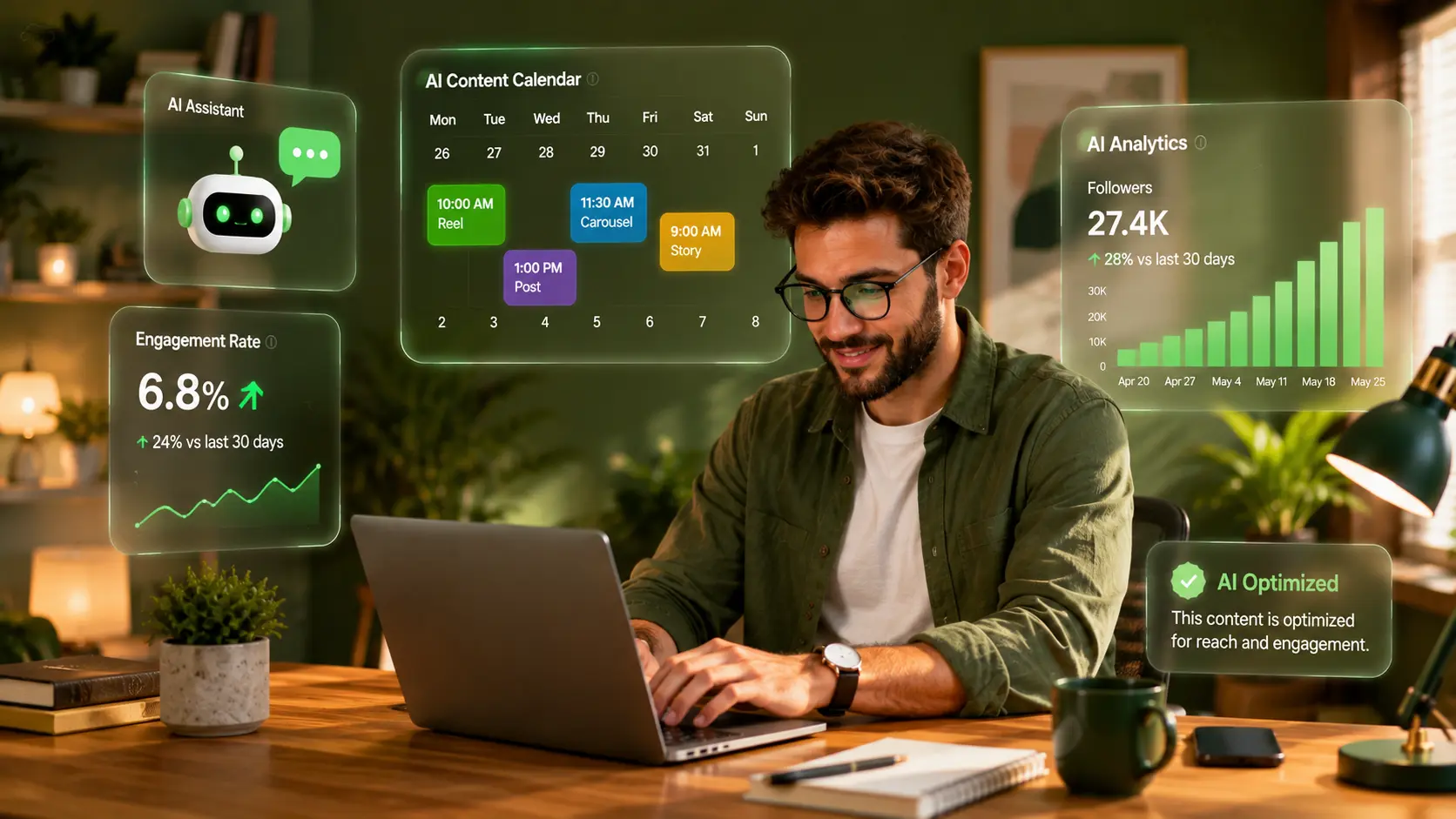
Influencer marketing has changed more in the last two years than in the previous ten. The playbook that worked in 2023 (find creators manually, brief them once, hope for the best) is now leaving serious performance on the table. Brands that have integrated AI at every stage of their influencer campaigns are shipping more content, testing more variations, and hitting higher conversion rates than teams still running the old process.
The shift is not subtle. Where a traditional influencer campaign might run one hero visual per creator and one iteration per quarter, AI-native campaigns run five to ten variations per creator and three to five iterations per month. That compounding difference is what turns AI-powered influencer marketing from a marginal efficiency gain into a genuinely durable competitive advantage over 12 to 18 months.
Here is what most guides get wrong: they treat AI in influencer marketing as one thing (usually just content generation). It is actually seven distinct stages, and AI genuinely improves every single one when used correctly. This guide walks through exactly how to use AI at each stage of a real influencer marketing campaign, from goal-setting through iteration, with the specific Templix tools that fit into each step of the workflow.
The guide is written for both sides of the campaign: brand and agency teams running influencer partnerships, and creators looking to work more efficiently with AI-assisted production. The workflow is the same on both sides. What differs is which specific steps you own versus collaborate on with the other party.
What Is AI Influencer Marketing?
AI influencer marketing is the use of artificial intelligence tools across any or all stages of an influencer campaign: creator discovery, content briefing, production, publishing, analytics, and iteration. It spans three main applications: fully AI-generated influencer personas (branded virtual characters), AI-assisted human creators (real influencers who use AI tools to produce content faster and better), and AI-powered campaign management (platforms that automate creator discovery, campaign coordination, and performance tracking).
The most common misconception is that AI influencer marketing means replacing human creators with virtual personas. In practice, the highest-ROI applications right now are the ones that give real human creators better tools, not the ones that try to eliminate the creator entirely. AI-generated content backed by a real human voice consistently outperforms fully synthetic content because audiences still trust real people over algorithms for personal recommendations.
Why Brands Are Turning to AI for Influencer Marketing
The reasons brands adopt AI in influencer marketing come down to speed, cost, and measurability. All three have gotten dramatically better over the last two years.
Creator discovery is faster: AI-powered discovery platforms surface relevant creators in minutes instead of weeks of manual outreach and shortlisting. This is where most brands see the biggest immediate time savings when they start.
Content production is cheaper: One creator with AI production tools can output what previously required a small studio. The economics of running weekly or daily campaign content have shifted permanently in favour of AI-assisted production.
Testing is measurable: AI makes it practical to produce and test five to ten creative variations of the same campaign asset instead of committing to one. The variation that actually converts often is not the one the team predicted.
Analytics are richer: AI-powered attribution and engagement analysis go beyond surface metrics like impressions and give teams a clearer view of what is actually driving conversion.
For the companion guide covering 42 tested campaign ideas across seven verticals, our AI Influencer Marketing Ideas breaks down specific concepts you can plug into the workflow this guide describes.
How to Use AI for Influencer Marketing: The 7-Step Guide
Step 1: Define Clear Campaign Goals Before You Touch Any AI Tool
The single most common failure mode with AI-powered influencer marketing is treating the tools as the strategy. AI accelerates execution. It does not decide what you should be executing on. Before opening any tool, define:
What specific outcome you are optimising for (awareness, engagement, direct conversion, product launch, brand repositioning)
Which platforms the campaign will run on (each platform has completely different content grammar and audience behaviour)
Which audience segments the campaign is targeting (age range, interests, geography, existing brand awareness level)
What success looks like in measurable terms (target CTR, conversion rate, engagement rate, or attributed revenue)
Without these decisions locked in, AI tools will produce faster, more polished output that misses the point. With them locked in, every subsequent AI-assisted step compounds against a clear target rather than a vague brief.
Step 2: Use AI to Find the Right Creators
Manual creator discovery is one of the most time-consuming parts of any influencer campaign. AI discovery platforms match brands to creators based on audience alignment, engagement quality, content style, and past campaign performance in a fraction of the time.
The workflow that works best in 2026:
Start with your defined audience segment and let AI discovery tools surface creators whose actual audience (not just their stated niche) matches.
Filter by engagement rate and audience quality signals rather than raw follower count, since inflated follower counts remain a persistent problem in the category.
Look at the creator's last 20 to 30 posts to assess whether their organic content quality matches what they typically deliver on brand partnerships.
Shortlist five to ten creators for a first outreach rather than committing to one, because response rates on cold creator outreach remain low even with a strong pitch.
The best AI discovery platforms flag potentially fraudulent engagement patterns, which saves the budget wasted on creators with purchased followers or engagement pods.
One less obvious use of AI at this stage: pattern-matching your best-converting past creator partnerships against the current creator database to find lookalikes. If your last campaign converted well with a specific creator, AI can surface twenty other creators with similar audience demographics, similar content style, and similar engagement patterns. This lookalike approach consistently outperforms starting from scratch on every new campaign, because you are optimising against what actually worked for your specific product and audience rather than against generic industry benchmarks.
Step 3: Brief Creators Using AI-Enhanced Content Planning
The creator brief is where most campaigns quietly fail. Vague briefs produce inconsistent content. Over-scripted briefs produce content that reads as advertising and underperforms in feed. AI can help you find the balance.
Use AI to draft the initial brief structure covering the campaign narrative, the specific hooks you want the creator to test, the visual references, and the platform-specific format requirements. Then let the creator refine it against their own voice and audience knowledge. The AI-drafted framework speeds up the briefing conversation without imposing a rigid script that kills the creator's actual value: their voice.
For teams producing multiple campaign briefs per week, Nano Banana 2 can generate visual reference boards and mood-board thumbnails directly from a text description of the campaign concept, which gives creators clearer visual direction than written descriptions alone.
Generate Campaign Visuals Free
Step 4: Produce Campaign Assets with AI Content Tools
This is the stage where AI has the most dramatic impact on cost, speed, and creative range. Instead of producing one hero visual and hoping it converts, you can produce ten variations from the same core concept in the time it used to take to brief a single shot.
The economics change fundamentally at this step. Traditional influencer content production runs on per-shoot cost structures where each new variation adds a meaningful budget. AI-assisted production runs on per-generation cost structures where the tenth variation costs roughly the same as the first. This inverts the standard incentive: teams that used to test one direction because that is what the budget allowed can now test five, learn which one actually converts, and scale the winner with the same total spend they used to commit to a single unverified concept.
The specific tools that fit each asset type:
Product-focused hero images and precision editing → Nano Banana 2 for photoreal composition and best-in-class text rendering
Editorial and lifestyle campaign visuals → Seedream 5.0 Pro for premium rendering and cinematic composition
Short-form video content for TikTok, Reels, and Shorts → Seedance 2.5 for 30-second single-pass cinematic clips with native audio
Cross-platform packaging into finished short-form video → the AI Reel Generator for TikTok, Reels, and Shorts formatting from a single generation
Consistent creator identity across a full campaign series → the AI Face Swap to lock the same presenter face across every asset
Dynamic character motion and gesture transfer → AI Motion Control for transferring real human movement onto AI-generated characters
For deeper prompt structure that produces the cleanest campaign visuals every generation rather than requiring multiple attempts, our JSON Prompting for AI Image Generation covers the structured approach that consistently outperforms free-text prompts.
One production principle worth internalising: the creators who get the best results from AI tools are the ones who treat AI as a collaborator rather than a replacement. AI handles the parts of production that used to be tedious (variation generation, format conversion, background changes, text overlays) while the creator focuses on the parts AI cannot replicate (personal voice, audience relationship, timing, cultural context). Teams that try to remove the creator entirely from the loop consistently produce content that reads as generic. Teams that use AI to give the creator more time and range consistently produce content that reads as elevated.
Step 5: Publish Across Platforms with Platform-Native Formatting
Campaign assets that work on Instagram do not automatically work on TikTok, LinkedIn, or YouTube. Each platform rewards different aspect ratios, pacing conventions, and content grammars. Publishing the same file across all four is one of the most common ways brands leave performance on the table.
AI tooling now handles the reformatting step automatically. The same core creative direction produces a 9:16 vertical for TikTok and Reels, a 1:1 square for Meta feed, a 16:9 horizontal for YouTube, and a 4:5 portrait for Instagram carousels in a single generation session. This eliminates the manual re-editing pass that used to gate multi-platform campaigns behind additional production time.
For teams running paid promotion on top of organic influencer posts, our Ad Hooks covers the hook-writing framework that consistently drives higher click-through when boosting influencer content through paid channels.
Step 6: Track Performance with AI-Powered Analytics
AI analytics go beyond the vanity metrics platform dashboards surface by default. The metrics that actually predict campaign success are engagement rate normalised for follower count, save and share rate (which signals genuine value rather than casual interest), and downstream conversion attribution across the full buyer journey.
Track from day one:
UTM-tracked links for every creator to isolate performance by partnership.
Unique discount codes tied to specific creators for direct conversion attribution.
Platform-native analytics for engagement, watch time, and save rate on each piece of content.
Cross-channel attribution to understand which creator introductions convert weeks or months after initial exposure.
The last one matters more than most brands realise. A creator who introduces your product but does not convert immediately often drives conversion through a completely different channel (direct search, retargeting, another creator mention) weeks later. Attribution windows shorter than 30 days significantly underestimate influencer campaign impact.
The other metric worth tracking that most teams ignore: comment quality. Automated engagement analysis can differentiate between low-value comments (single emojis, generic reactions, "great post" style filler) and high-value comments (specific questions about the product, tagged friends, purchase-intent language). A post with fewer comments but higher-quality signal often converts significantly better than a viral post loaded with low-value engagement, and only AI-powered analysis surfaces that distinction cleanly. This is one of the reasons why raw engagement rate is a misleading metric when isolated from comment quality analysis.
Step 7: Iterate and Scale What Actually Works
The final and most valuable step is where most campaigns end prematurely. After two weeks of running the first version, the strongest brands identify which specific creators, formats, and creative directions are actually generating the response the campaign was optimised for, then double down on those variables in the next iteration.
Iteration questions worth answering every cycle:
Which creators produced the highest engagement per dollar spent, and can we build a longer-term partnership with them?
Which specific hook or creative format tested strongest, and how do we produce more variations built on that same underlying approach?
Which platforms delivered the strongest ROI, and should the budget shift toward those in the next campaign?
Which creator format performed best (long-form, Shorts, static posts, Stories, Lives), and what does the ideal mix look like next time?
Compounding is where AI-powered campaigns pull decisively ahead of traditional ones. The team that runs four iterations in the time it takes a traditional team to run one is not just faster. They have four times the learning, which compounds into permanent performance advantages over multiple campaign cycles.
One additional discipline worth building into every iteration: separate the campaign into its component parts and test each one independently rather than treating each cycle as a monolithic experiment. If a campaign underperforms, was it the creator selection, the hook, the format, or the platform? Traditional campaigns often cannot answer that question because everything was tested together. AI-powered campaigns with cleaner attribution can isolate each variable and identify the specific source of underperformance, which means the next iteration can fix the actual problem rather than changing everything and hoping.
Best AI Tools for Each Stage of Influencer Marketing
The stack that works in 2026:
Creator discovery: Modash, HypeAuditor, and CreatorIQ for AI-powered matching across audience data and engagement signals
Content briefing: AI-drafted brief structures paired with visual reference boards generated in Templix
Content production: Templix for the full image and video generation stack including Nano Banana 2, Seedream 5.0 Pro, Seedance 2.5, and the Ad Studio
Cross-platform publishing: Later, Buffer, or Sprout Social for scheduled distribution across every social surface from a single asset set
Performance analytics: Native platform analytics combined with UTM tracking and attribution platforms like Northbeam or Triple Whale for full-funnel measurement
Campaign management: Grin, Aspire, or CreatorIQ for coordinating multi-creator campaigns at agency or brand-team scale
For agencies producing at consistent volume across multiple client campaigns simultaneously, the Ad Studio handles the paid-social packaging step once the organic influencer content proves out, turning winning creator content into scaled paid ad creative without a separate production cycle.
Common Mistakes to Avoid When Using AI for Influencer Marketing
Prioritising AI-generated content over authentic creator voice:The best AI influencer marketing combines AI production efficiency with real human authenticity. Fully AI-generated content that removes the human creator loses the trust signal that makes influencer marketing work in the first place.
Skipping the strategy step: AI tools accelerate whatever brief you feed them. If the brief is vague, the output is faster, more polished, and still off-target. Ten minutes on clear campaign goals saves ten hours on wasted iteration.
Optimising for follower count over engagement quality: AI discovery platforms surface both. Choose the creators with stronger engagement signals every time, even at smaller follower counts.
Treating AI campaign assets as final without human review: Even the best AI production output benefits from a human quality-check pass before publishing. This catches the small errors (a misspelled brand name in an overlay, an incorrect product colour, an off-brand tone shift) that would otherwise reach the audience.
Ending after one campaign cycle: Compounding is the entire advantage. Brands that run one AI-assisted campaign and treat it as a test capture almost none of the actual value. The value is in iteration across three, five, or ten cycles.
AI Influencer Marketing Examples That Actually Work
The formats consistently delivering results across categories in 2026:
Product demo Reels with AI-generated backdrops: A creator demonstrates a real product in an AI-generated location their production budget could never afford. Visual richness of a big-budget shoot at the cost of a one-person production.
Cross-market localised campaigns: The same creator content adapted for multiple regions by regenerating on-screen text, backgrounds, and cultural details for each market without reshooting. Region-level editing tools like those in Seedance 2.5 make this economical at scale for the first time.
Long-form YouTube brand narratives packaged into short-form clips: One 15-minute creator video becomes a full week of TikToks, Reels, and Shorts through automated repurposing. Compounds the value of each production cycle significantly.
AI persona-led product launches: Fully AI-generated brand ambassadors leading launch campaigns for brands that value creative control and identity consistency over parasocial trust with a specific human creator. Works particularly well for consumer software, ecommerce, and category-defining product categories.
Creator-led paid social campaigns: Organic creator content that outperforms during posting gets promoted through paid channels using the same creator's identity, extending reach without breaking the authenticity signal.
Start Using AI for Influencer Marketing With Templix
AI influencer marketing is not a future concept. It is what the strongest campaigns already run on in 2026. The brands that adopted these workflows early are on their third and fourth iteration of internal process, while brands still deciding whether to try AI are watching their competitors compound advantages they cannot easily catch up to.
The seven steps above are the workflow. The tools listed for each step are the current state of the stack. Templix covers the production layer end to end (image generation, video generation, precision editing, and ad packaging) in a single subscription with free credits on signup so you can test the entire pipeline before committing to a paid plan.
The most important thing to remember when adopting AI in influencer marketing: start with one stage of the workflow rather than trying to overhaul your entire process at once. Most brands see the biggest immediate wins by focusing first on content production efficiency, then expanding into creator discovery, analytics, and iteration cycles over the following two to three campaign cycles. Trying to move every stage of the workflow to AI simultaneously usually results in overwhelmed teams and half-implemented processes. Sequential adoption compounds better and gives your team time to actually learn each stage before adding the next.
Pick a use case. Brief a creator. Produce your first campaign asset with Templix.
Start Your First AI-Powered Campaign Free
Frequently Asked Questions
How do I use AI for influencer marketing as a beginner?
Start with one stage of the workflow rather than trying to overhaul your entire campaign process at once. Content production is the highest-leverage entry point for most brands because it delivers immediate cost and speed advantages. Use Templix to generate campaign visuals for your next creator brief, and expand from there once the workflow is working.
Is AI going to replace human influencers?
Not in the near term. AI-generated personas are growing as a category, particularly for brands that value creative control, but human creators still deliver the parasocial trust signal that makes influencer marketing genuinely convert. The strongest campaigns in 2026 combine AI production tools with real creators rather than replacing them.
What is Templix Nano Banana 2 and why does it fit influencer marketing?
Templix Nano Banana 2 is Google's precision image editing and generation model available on Templix. For influencer marketing specifically, it handles product photography editing, before-and-after visuals, on-screen text rendering for overlays, and photoreal composition. This makes it especially strong for beauty, skincare, product, and fashion campaigns where visual precision matters more than approximate output.
Is Templix free to use for influencer marketing content?
Yes. Templix offers free credits on signup so you can test Nano Banana 2 and every other tool on the platform at no cost. Paid plans unlock higher credit volumes and priority processing for creators and agencies producing campaign content at scale.
How do I measure the ROI of AI-powered influencer marketing?
Track direct conversion metrics (unique discount codes, UTM-tagged links, attributed sales) alongside engagement quality metrics (save rate, share rate, comment quality). Combine platform-native analytics with cross-channel attribution tools to see the full picture. Attribution windows shorter than 30 days consistently underestimate influencer campaign impact because much of the conversion happens through downstream channels weeks after first exposure.
Can AI find better influencers than manual outreach?
For breadth and speed, yes. AI discovery platforms surface relevant creators significantly faster than manual research. For depth of fit, human judgement still adds value, particularly in evaluating whether a creator's voice actually matches your brand. The strongest workflow combines AI-powered shortlisting with human evaluation of the final five to ten candidates.
What is the best way to brief a creator on an AI-powered campaign?
Provide a clear campaign framework covering the goal, the specific hook to test, visual references, and platform format requirements. Leave the execution voice to the creator. AI-drafted briefs work best as starting frameworks that creators refine against their own audience knowledge, not as rigid scripts.
Can I use Templix output commercially in paid influencer campaigns?
Yes. Images and videos generated on Templix are available for commercial use across paid influencer campaigns, sponsored content, ad creative, brand assets, and product marketing. This applies to output from every model and tool available on the platform.
How often should I iterate on AI-powered influencer campaigns?
Every two weeks is a strong default cadence for campaigns spending above modest daily budgets. Identify which creators, formats, and creative directions performed best in the last cycle, then build the next iteration around those winning variables. Compounding across three to five iterations is where the real performance advantage of AI-powered campaigns shows up.
What is the biggest advantage of AI in influencer marketing over traditional workflows?
Speed of iteration. Traditional influencer campaigns typically run one to two iterations per quarter because of production and coordination overhead. AI-powered workflows compress that to weekly or bi-weekly cycles, which means the brand learns four to eight times faster than a traditional competitor and compounds those learnings into permanent performance advantages over 12 to 18 months.

Sana Iqbal
Sana Iqbal writes on marketing and design for Templix, focusing on AI-powered apps and campaigns that help creators grow audiences and scale their content.