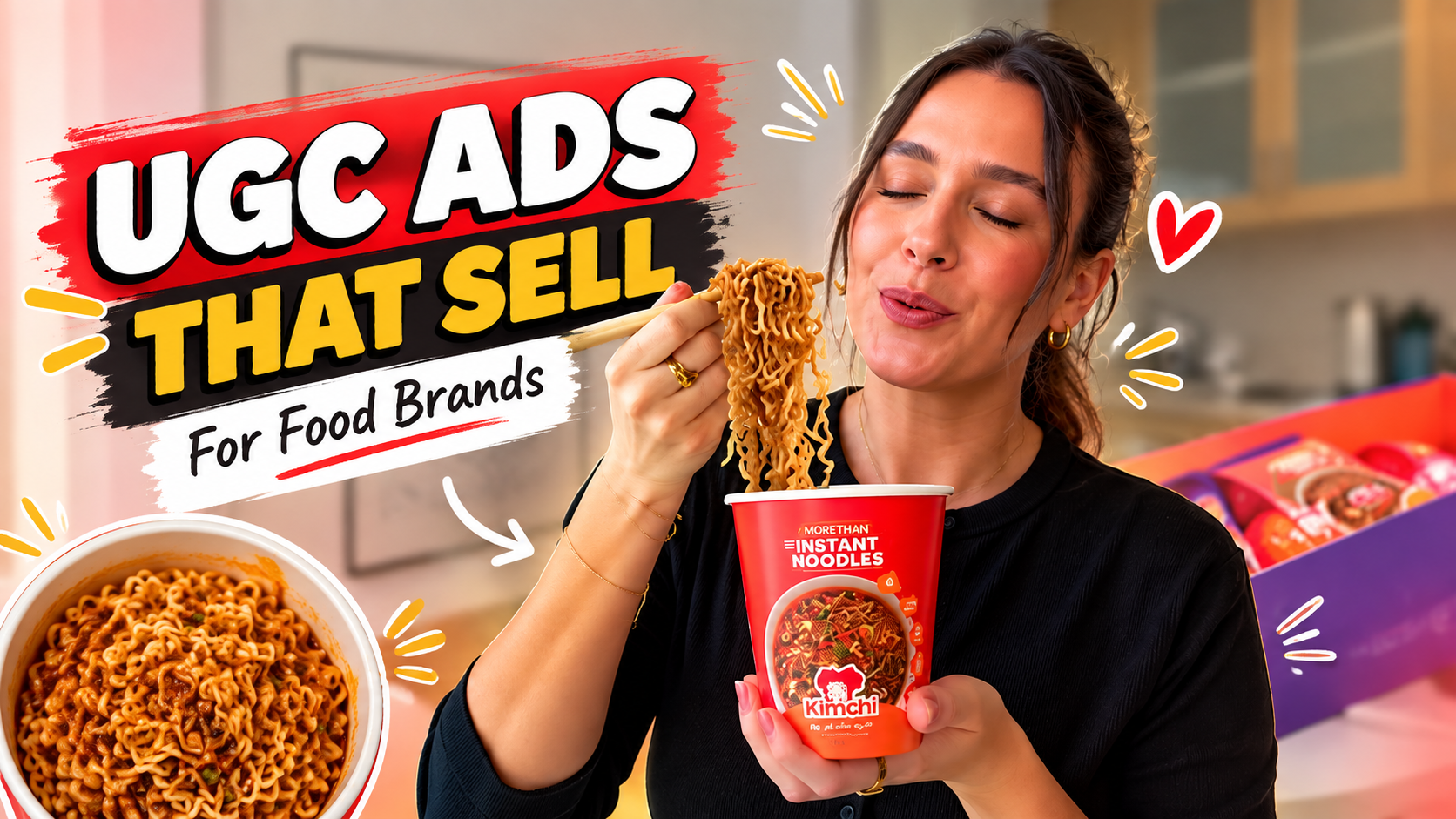
This 24 second ad does everything a food ad should do. A bold claim in the first second (“guilt free instant noodles”), an unboxing, two flavours shown, two numbers that matter (200 calories, 6g fibre), water poured in, a 5 minute timer, and a first bite. It was made with an AI creator and the product’s own packaging.
Food is the easiest category to sell with UGC and the easiest to get wrong. Easy because people buy food with their eyes and a 15 second video shows more than any product page. Wrong because most food ads look like TV commercials, and nobody trusts a TV commercial about noodles.
This guide shows what makes a food UGC ad sell, with scripts, the three shots you cannot skip, and the exact workflow used for the noodle ad above.
Why UGC works better than polished ads for food
People do not buy food because it is beautiful. They buy it because someone like them ate it and liked it. That is the whole logic of UGC.
A studio ad shows a perfect bowl under perfect light. A UGC ad shows a real person in her kitchen, slightly messy counter, eating it with chopsticks and making the face you make when something is good. The second one sells more, every time, because the viewer can see herself in it.
Three things food UGC does that polished ads cannot:
It proves the product is real. Unboxing, opening the lid, pouring the water. Each step is proof.
It shows the moment that matters. The first bite. No product shot can replace a reaction.
It feels like a recommendation, not an ad. Which is why the brand name comes last, not first.
The 3 shots every food UGC ad needs
Before scripts, before hooks, get these three shots. Miss one and the ad feels incomplete.
Shot 1: The product, clearly
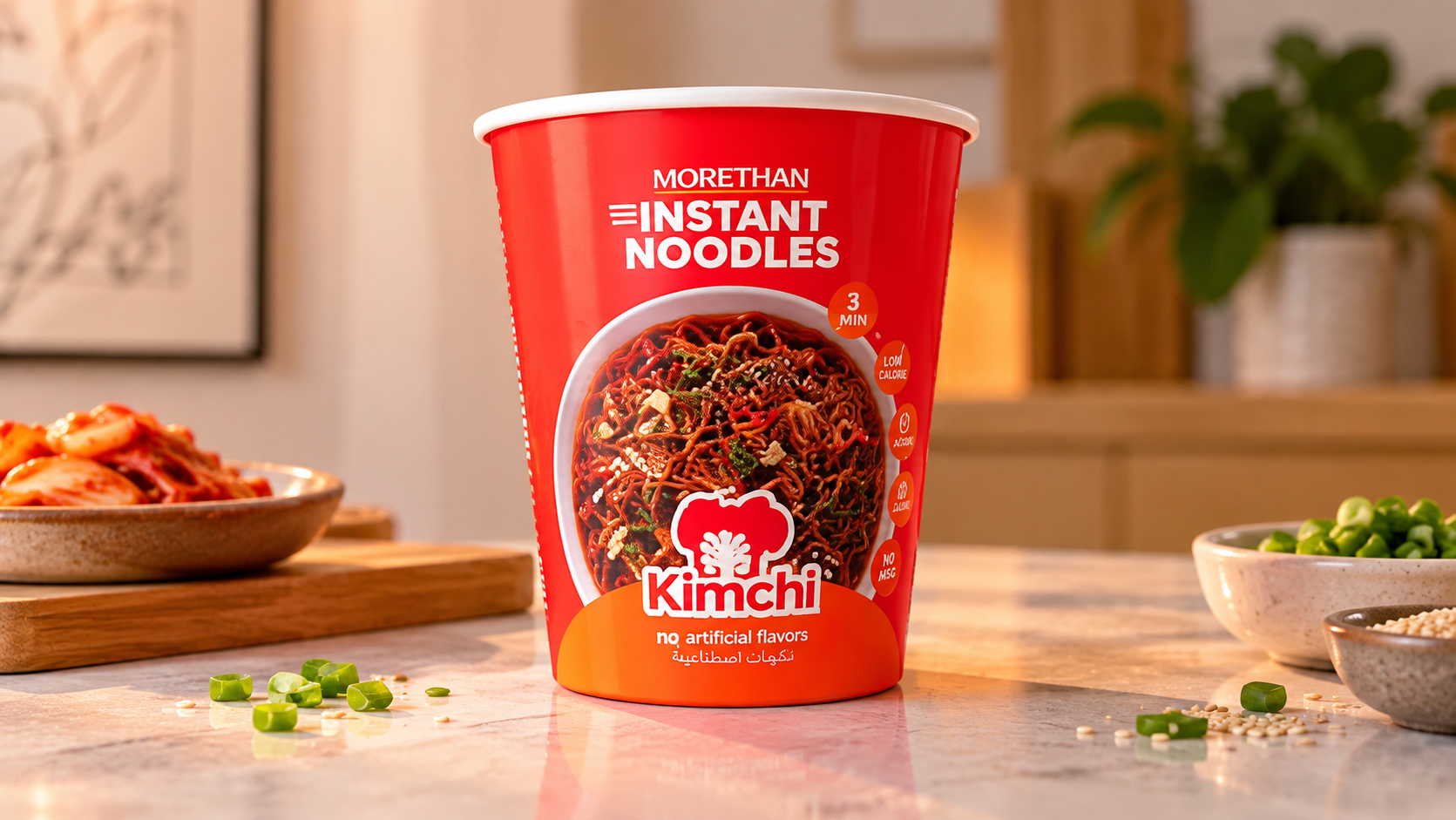
The viewer needs to recognise the pack on a shelf later. So the pack has to be in frame, label readable, for at least two seconds. Not spinning. Not half covered by a hand.
The noodle cup above is a good example: red pack, flavour name big, “3 min”, “low calorie” and “no MSG” readable, real kitchen behind it with kimchi and spring onions, not a white studio table. The product is the hero but the kitchen makes it believable.
This is also the image you give the AI as the product reference. A clean, well-lit packshot in a real setting gives the model a clear idea of what the creator should be holding.
Shot 2: The creator eating it
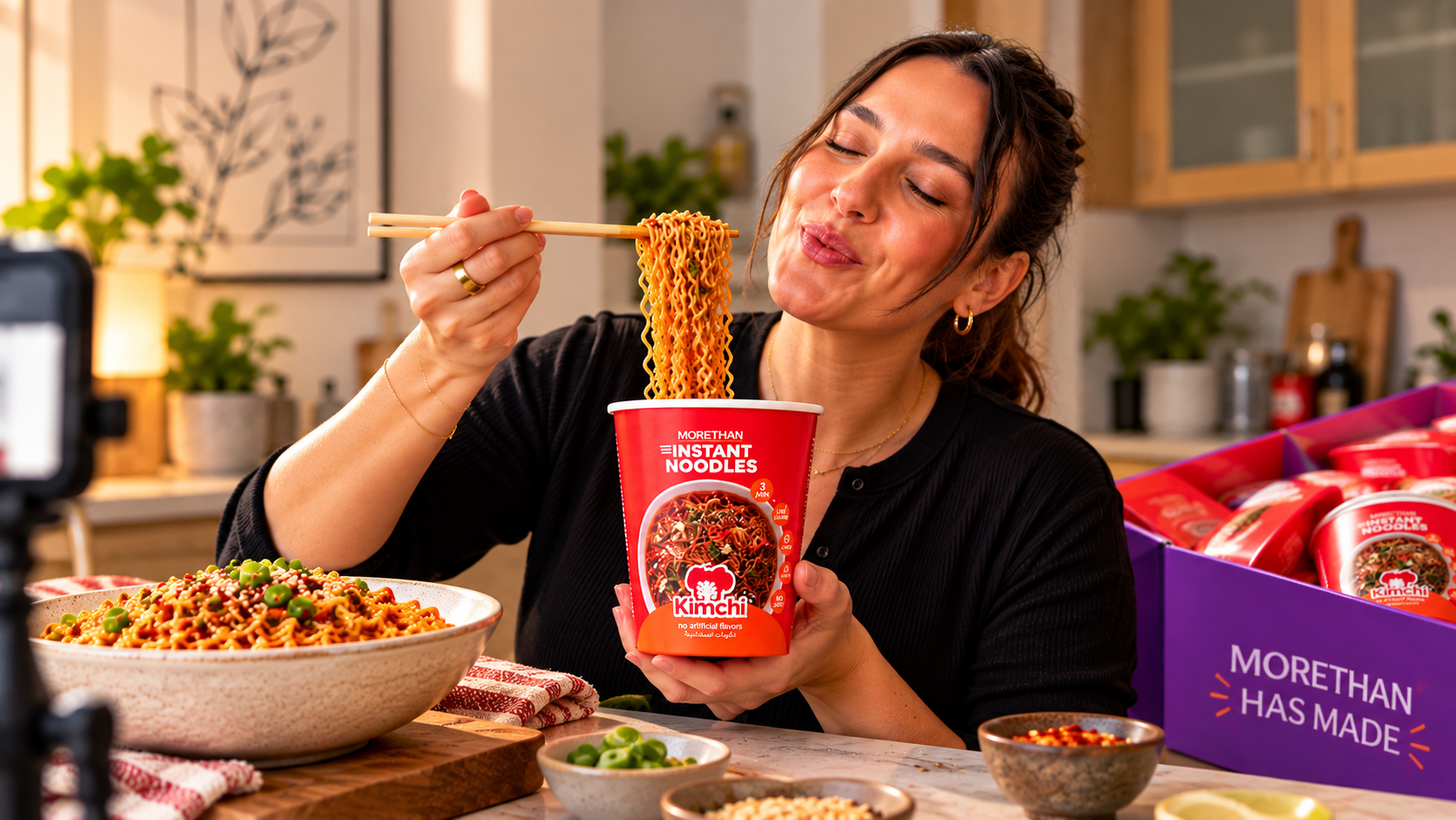
This is the shot that sells. Not holding the product. Eating it.
Look at what works in this frame: eyes closed, cheeks full, chopsticks lifting a long pull of noodles out of the cup, the purple delivery box with more cups behind her, a bowl of the cooked noodles in front. Everything in frame says “she actually ate this”.
Rules for the eating shot:
Chopsticks or fork lifting food out of the pack, not a plated bowl.
A real reaction. Eyes closed, a nod, a small laugh. Never a wide fake smile at the camera.
Warm kitchen light, not a ring light.
Something slightly messy. A towel, a used bowl, the box it came in.
Shot 3: The food, close
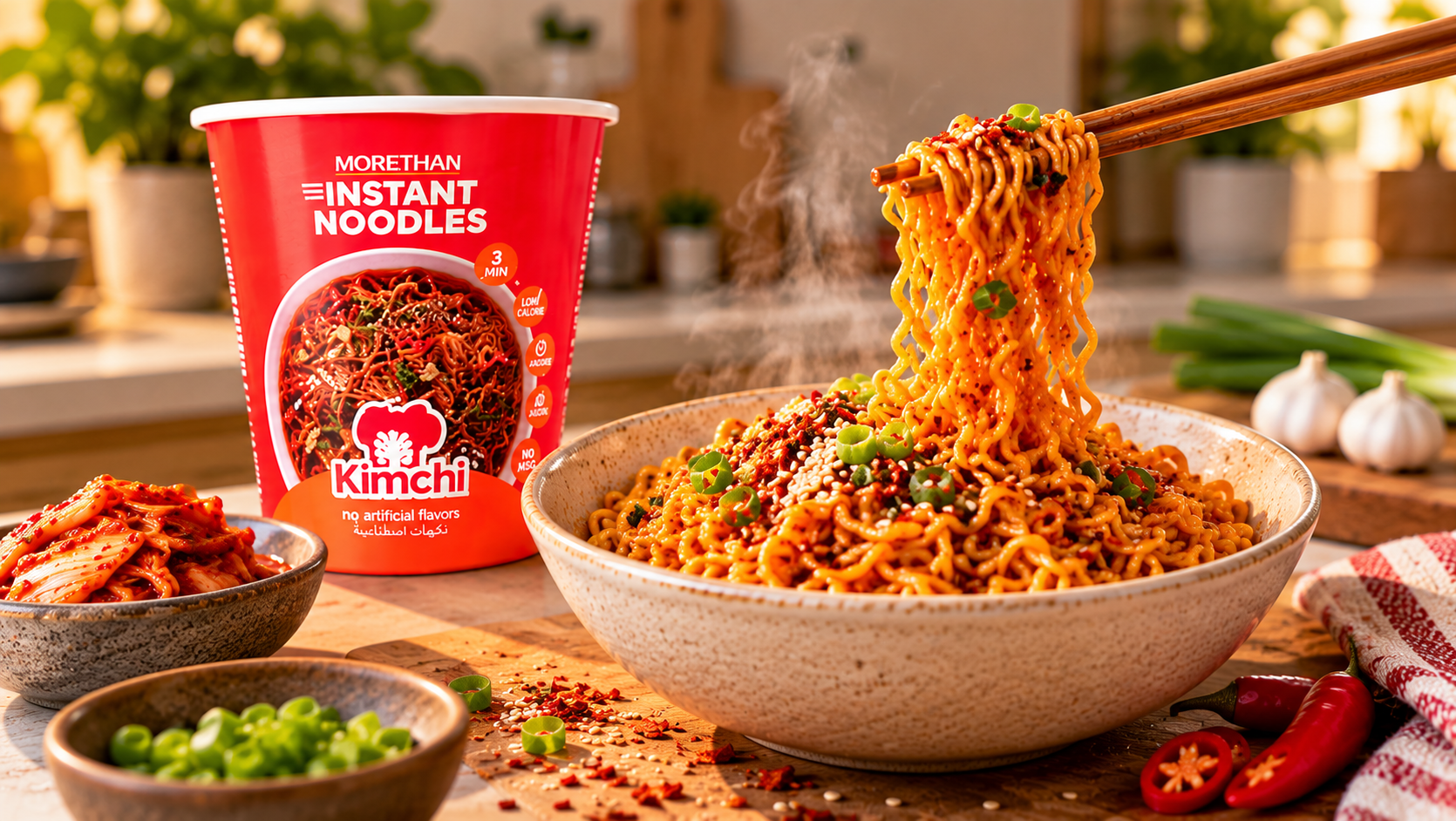
Appetite appeal. Steam, sauce, texture, a lift. This is the shot that makes someone hungry at 11pm and tap the link.
For noodles: a chopstick pull with the noodles still glossy with sauce, steam visible, toppings on top, the cup in the background so the viewer connects the bowl to the pack. Keep it one to two seconds. Longer and it starts to look like a cooking show.
Hooks that work for food ads
The first second decides everything. Use one of these, spoken or as on-screen text, with the creator already on camera.
The guilt hook. “Guilt free instant noodles.” (This is the one in the ad above.)
The number hook. “200 calories and 6g of fibre. In instant noodles.”
The disbelief hook. “I did not believe this was instant.”
The time hook. “Lunch in 5 minutes, and it is actually good.”
The comparison hook. “Better than the ones I grew up on. Hear me out.”
The craving hook. “When the 11pm craving hits, this is what I do now.”
Pick one claim. Food ads die when they try to say five things. The noodle ad says “guilt free” and then proves it with two numbers. That is the whole structure.
The script structure (15 to 25 seconds)
Food runs a little longer than skincare or tech because the eating shot needs time. Twenty to twenty-five seconds is fine. Structure:
0 to 2s: hook. One claim, creator on camera, product in hand.
2 to 8s: unbox or open. Show the pack, the flavours, the lid coming off. Proof it is real.
8 to 14s: the one reason. Calories, ingredients, time to cook. One thing, two numbers maximum.
14 to 20s: make it. Pour the water, timer on screen, the lid back on.
20 to 25s: eat it. First bite, reaction, soft CTA.
The noodle ad follows this almost exactly: “guilt free” hook, purple box opened, two flavours held up, “200 calories and 6g of fibre”, water poured, 5 minute timer, first bite.
A script you can copy for any instant food product:
Guilt free instant noodles. I know. Hear me out.
These just arrived and there's a kimchi and a tom yum.
They're 200 calories a cup and 6 grams of fibre, which is not normal
for noodles.
Water in, five minutes, done.
Okay. That's actually really good. Link's in the bio.
How to make a food UGC ad with AI
Hiring a creator to make this takes a week: brief, ship the product, wait for the video, wait for edits. For food it is worse, because the product can spoil and the creator has to cook it properly on camera.
Here is the workflow that made the noodle ad, using the three images above.
Step 1: The product image. Use a packshot like Image 1 as the product reference. Label readable, real kitchen, warm light.
Step 2: The creator. Build one in the UGC character generator or pick one from the Community. For food, go casual: a dark t-shirt, hair up, a real kitchen, natural skin. The creator in Image 2 is a good template: late 20s, hair tied back, gold hoops, black top, warm kitchen. Save the image and reuse it in every ad so the brand gets one recognisable face.
Step 3: The ad. Open the UGC ad generator. Upload the creator as @image1 and the pack as @image2. Describe the ad in one box. The prompt used for the noodle ad:
@image1 in a warm kitchen, phone on a tripod, slightly off centre. She
holds @image2 up to camera and says "guilt free instant noodles, hear me
out". She opens a purple delivery box on the counter and lifts out two
cups, kimchi and tom yum, showing the labels. Close-up of the kimchi cup
as she pours hot water in and presses the lid down. On-screen timer.
She lifts a long pull of noodles out of the cup with chopsticks, eyes
closed, cheeks full, small nod. Ends holding the cup to camera.
Warm afternoon light, lived-in kitchen, towel and used bowl on the
counter. Natural skin texture, no beauty smoothing, no studio lighting,
no fast cuts.
Settings: 9:16, 720P, sound effect on. Expect two or three attempts. Keep the one where the eating reaction looks real.
Step 4: Variations. Same creator, same pack, three different hooks. Use the UGC video generator for the short non-ad clips between them (a “what I eat for lunch” clip, a pantry restock) so the face shows up in both ads and organic content. Use the UGC image generator for stills: the creator holding the cup for a thumbnail, the bowl for a carousel.
Cost per finished ad is around $2 across three attempts. A human creator for the same brief is $150 to $500 plus shipping the product plus a week.
Make your food brand’s first UGC ad on Templix
Mistakes that kill food UGC ads
Starting with the brand name. Nobody cares yet. Start with the claim.
A plated bowl instead of the pack. The viewer cannot buy a bowl. Show the pack she will see on the shelf.
No eating shot. A food ad without a bite is a product video, not UGC.
Fake reaction. Wide smile at the camera reads as paid. Eyes closed and a nod reads as real.
Too many claims. Pick one. Prove it with one or two numbers.
Studio lighting. Food UGC lives in kitchens. Warm, one direction, slightly messy.
Perfect creator. Glass skin and a fake kitchen make the whole ad look like AI, even if the food is real. Ask for natural skin texture every time.
Where to run food UGC ads
Meta and TikTok paid. Same ad, three hooks, let the platform pick the winner. Food creative fatigues fast, so plan a new hook every two weeks.
Organic Reels and TikTok. The eating shot works as a standalone clip. Post it with the hook as on-screen text.
Product pages. A 15 second clip of someone eating it next to the add-to-cart button.
Marketplace listings. Many marketplaces now allow short video in listings. The pack-plus-bite clip is ideal.
Frequently Ask Question
What makes a good UGC ad for a food brand? A bold claim in the first second, the pack shown clearly, one proof point with a number, and a real eating shot with a real reaction. Keep it 15 to 25 seconds, filmed in a kitchen with warm light.
How long should a food UGC video be? Fifteen to twenty-five seconds. Food runs slightly longer than other categories because the eating shot needs two to three seconds of its own. Anything over thirty seconds starts to feel like a cooking video.
Can I use AI to make UGC ads for food products? Yes. Use a clean packshot as the product reference and a casual creator in a real kitchen. Describe the unboxing, the cooking step and the eating reaction in the prompt, and ask for natural skin texture and warm light. The noodle ad in this guide was made this way.
What should the creator say in a food UGC ad? One claim, one or two numbers, then a reaction. For example: “Guilt free instant noodles. 200 calories and 6 grams of fibre. Water in, five minutes. Okay, that is actually good.” No brand name in the first sentence.
How much does a food UGC ad cost? With AI, about $2 per finished ad across two or three attempts, with no product shipping. A human UGC creator charges $150 to $500 per video, plus shipping and a week of turnaround, and food products add the risk of spoiling in transit.

Fatima Sheikh
Fatima Sheikh explores AI-powered apps at Templix, writing accessible guides that show everyday creators how to unlock powerful tools without any technical barriers.