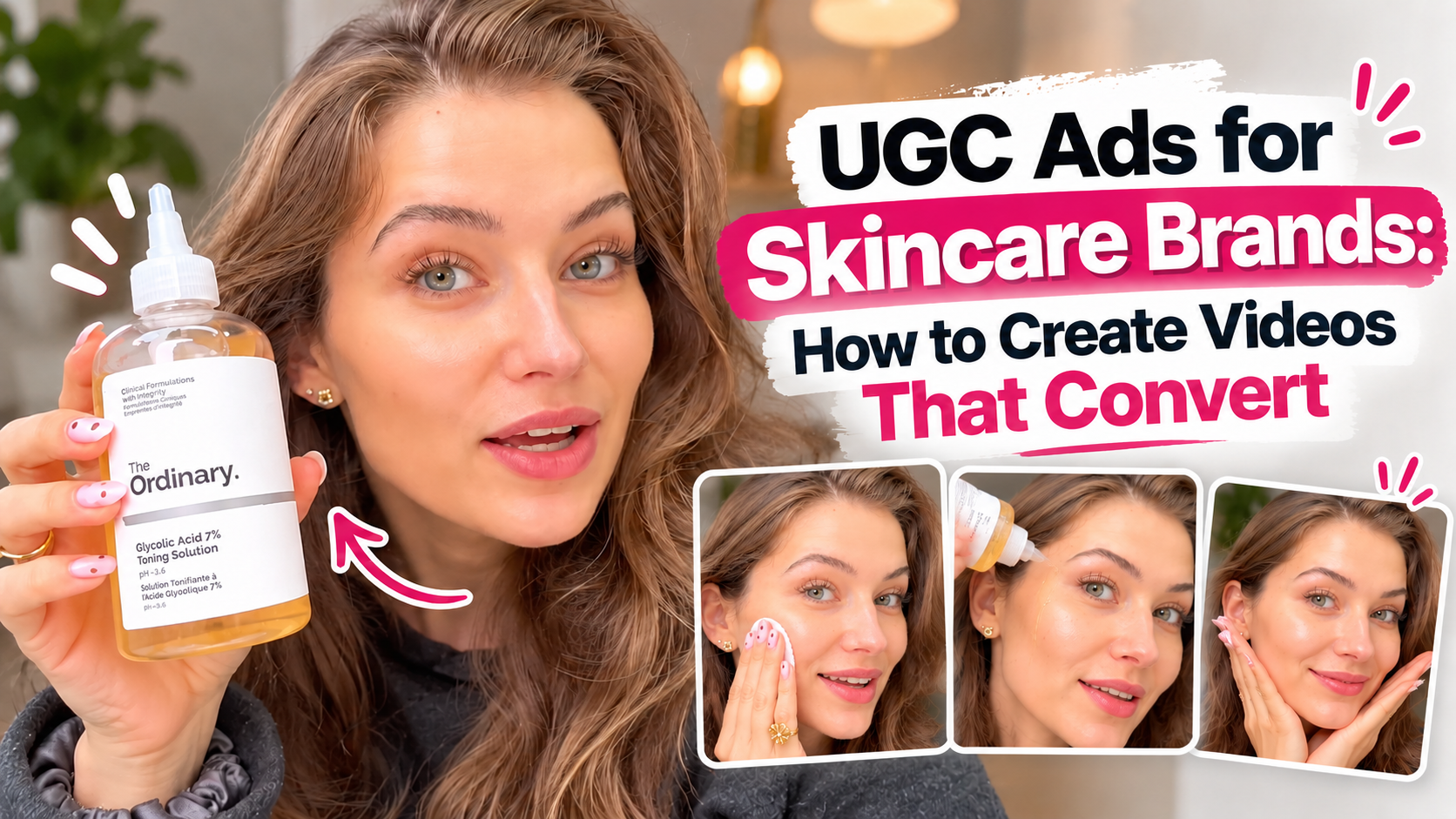
This 34 second ad does what every skincare ad should do. A creator talks to camera like she is on FaceTime, holds the bottle up so the label is readable, pours the toner onto a cotton pad, swipes it across her forehead, and brings the bottle back to the lens at the end. No studio. No voiceover. No “introducing”. It was made with an AI creator and one product image.
Skincare is the category where UGC works best and where it fails hardest. Best, because people will not buy a product for their face from a glossy commercial. They buy it because someone with normal skin said it worked. Hardest, because the moment the creator looks retouched, every claim in the ad stops being believable.
This guide covers what makes a skincare UGC ad convert: the four shots you cannot skip, the hooks that work for this category, a script you can copy, and the exact workflow behind the toner ad above.
Why skincare needs UGC more than any other category
A food ad can win on appetite. A gadget ad can win on a demo. A skincare ad has to win on trust, because the viewer is about to put something on her face and she cannot see the result before buying.
UGC solves that in three ways:
A face she can compare to her own. Real skin texture, normal lighting, no filter. If the creator’s skin looks like hers, the result feels possible.
The product applied, not just held. Seeing the toner go on a cotton pad and onto the skin is proof the creator actually uses it.
Talking, not announcing. “Okay I have to show you this” earns more trust than any claim on the label.
Polished skincare ads show a result. UGC shows a routine. Routines are what people copy.
The 4 shots every skincare UGC ad needs
Get these four and the ad works. Miss one and it feels like a product video.
Shot 1: Talking to camera with the product in hand
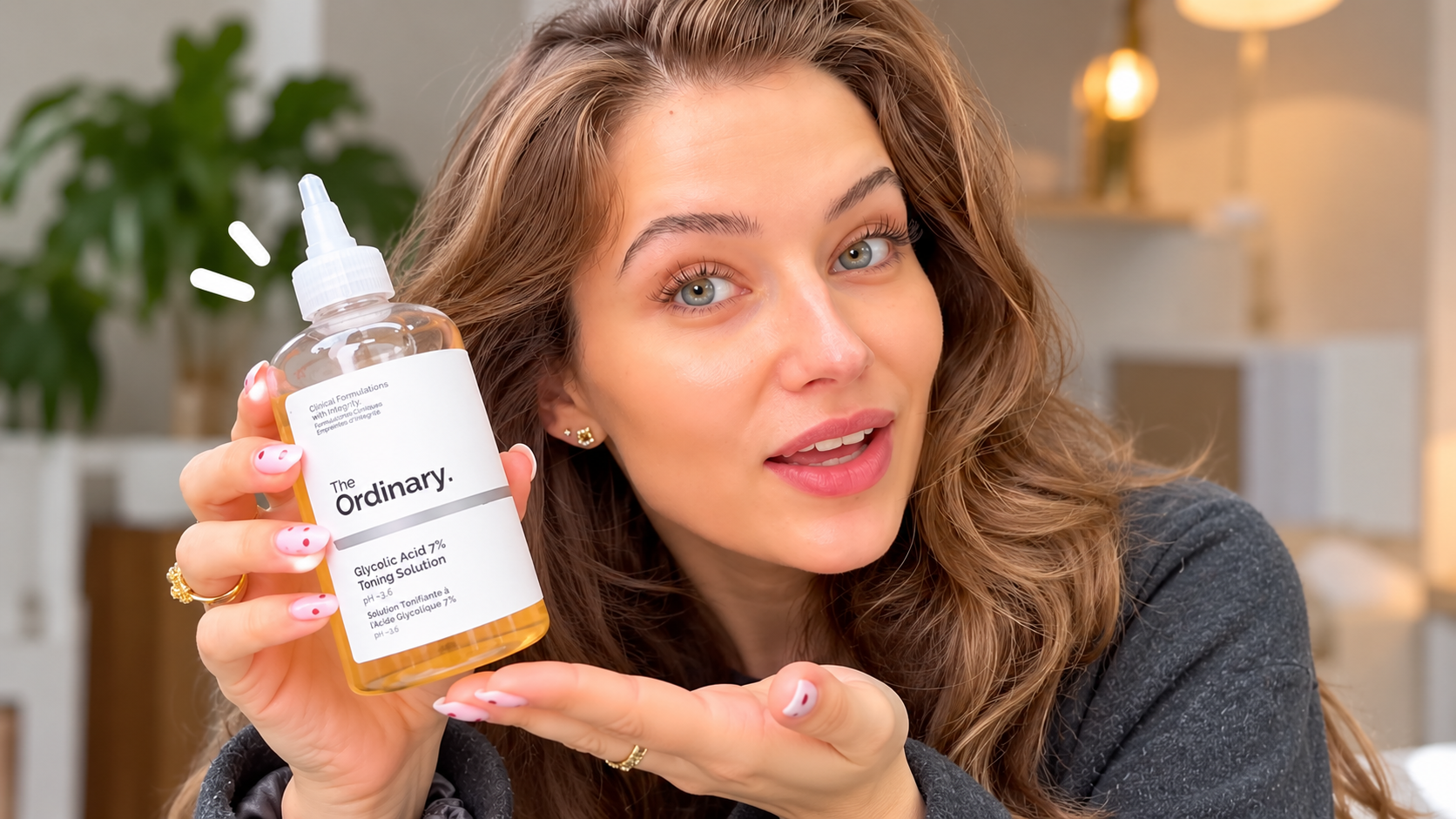
This is the shot that opens the ad and carries most of the talking. Creator close to the lens, bottle held at face height, label turned to camera, eyes on the viewer. The living room behind her is soft and warm, not a white wall.
What makes this frame work: she is mid-sentence. Her mouth is open, her eyebrows are up, she is explaining something. A creator who is talking looks like a friend. A creator who is posing looks like a model.
Keep the bottle in this shot for at least two seconds with the label readable, so the viewer can recognise it on a shelf later.
Shot 2: The product going on
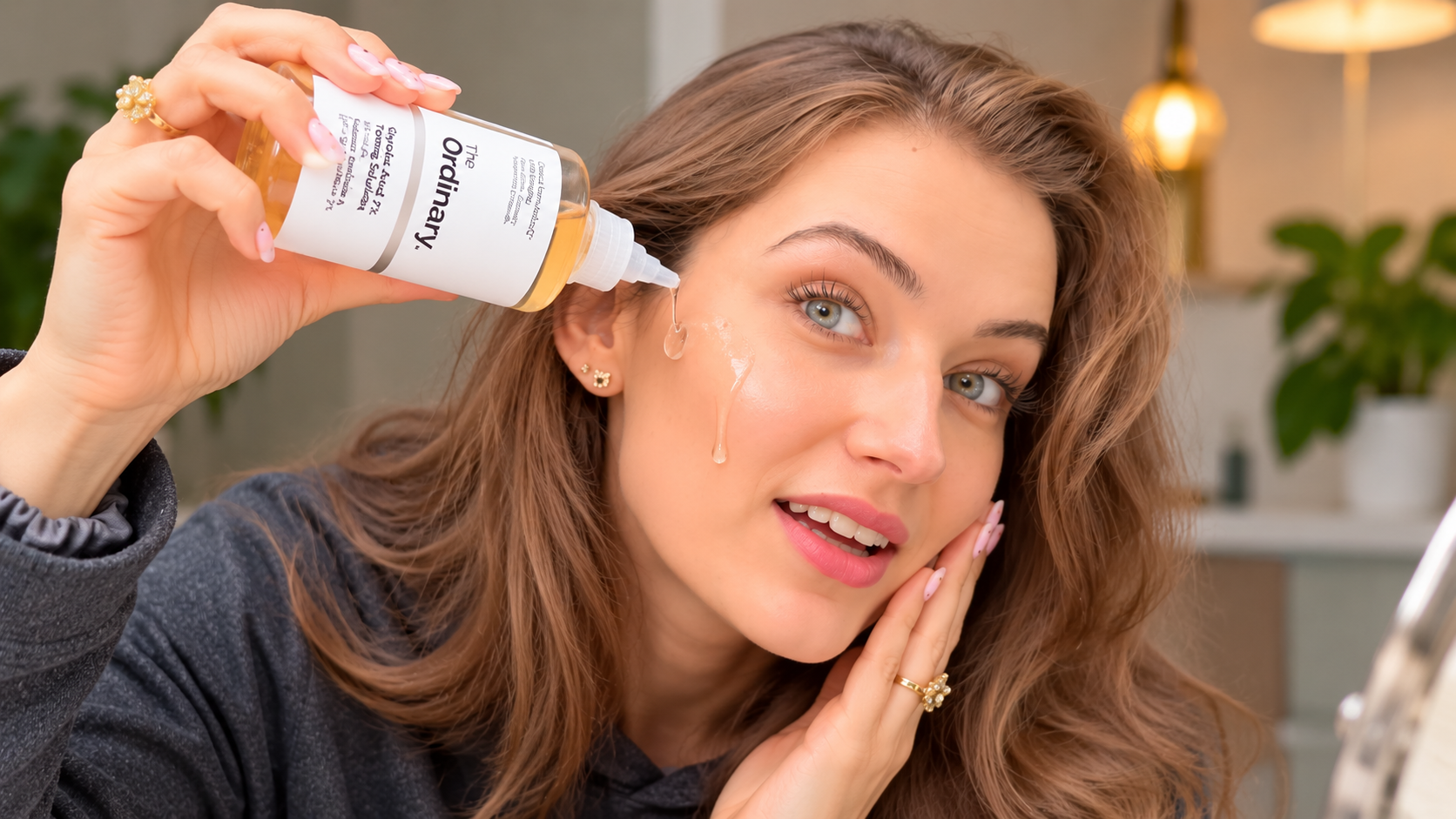
Application is the proof shot. For a toner it is the pour. For a serum it is the dropper. For a cream it is the swipe. Whatever the product, the viewer has to see it touch skin.
The frame above shows the toner leaving the bottle and running down her cheek. It is slightly messy, which is the point. Perfect application looks staged. A drop running where it should not reads as real.
Shot 3: The routine step
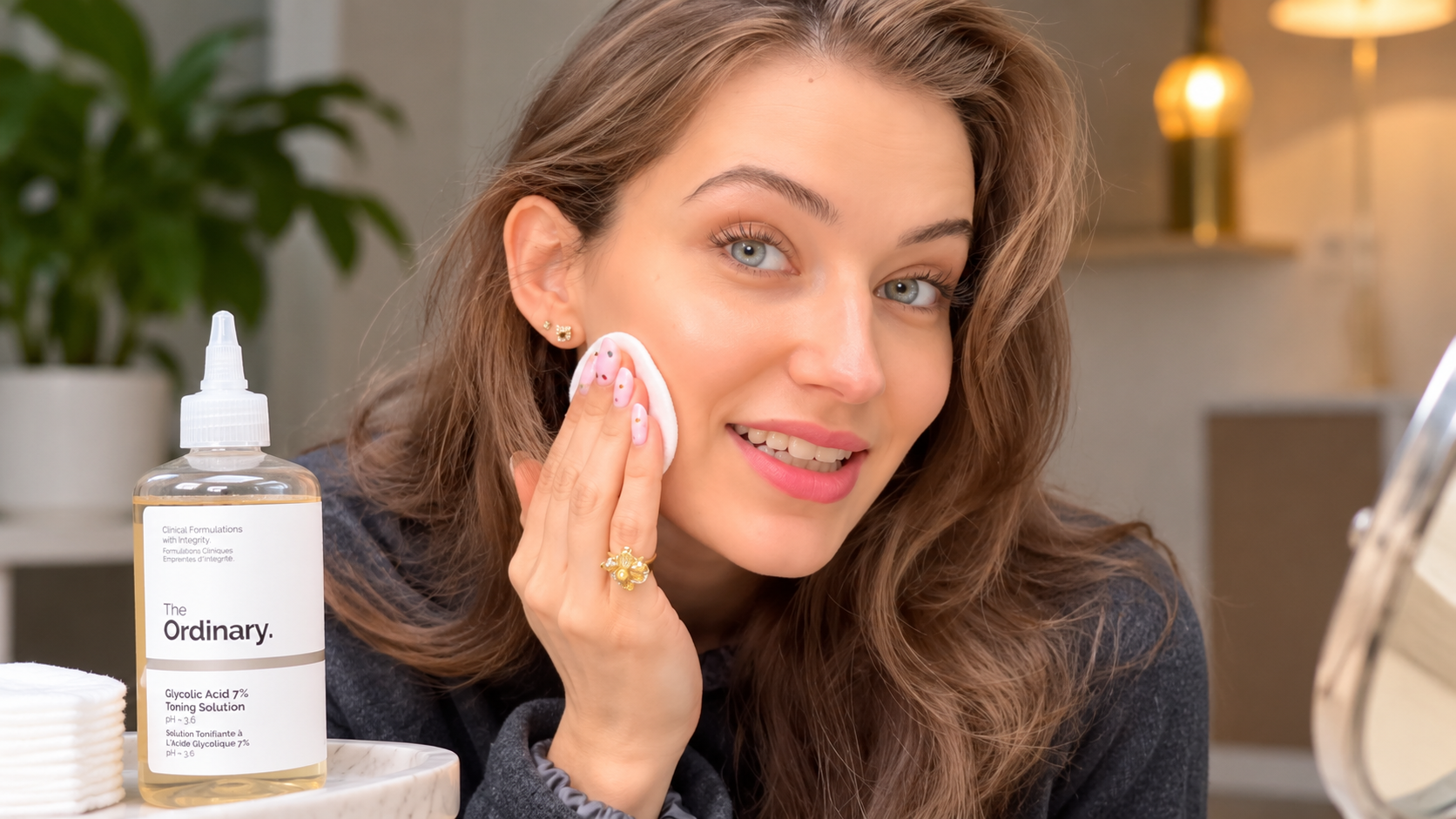
Show the product being used the way a customer would use it. Cotton pad on the cheek, bottle and the stack of pads in frame, mirror at the edge of the table. This is the shot that teaches the viewer how to use the product without a single word.
Keep the props real: cotton pads, a mirror, a plant behind her. Props from a real bathroom or dressing table make the ad look like it was filmed at home.
Shot 4: The skin, close
Skincare ads live or die on skin texture. Somewhere in the ad there has to be a close-up where the viewer can see pores, a little shine, a natural flush. In the toner ad it is the forehead swipe and the final bottle-to-lens shot with her face just behind it.
If the close-up shows glass skin, the viewer stops believing the product did anything. Real skin in the close-up is the single biggest conversion lever in this category.
Hooks that work for skincare
The first two seconds decide whether anyone sees the application shot. Use one of these, spoken, with the creator already on camera.
The confession hook. “I have been putting this on my face every night for a month. Here is what happened.”
The texture hook. “If your skin feels bumpy and dull, this is the one thing that fixed mine.”
The price hook. “This costs less than my coffee order and I will never stop using it.”
The “do not” hook. “Do not buy this until you know how to use it properly.”
The routine hook. “Three steps, two minutes, this is my whole night routine now.”
The disbelief hook. “I did not think a toner could do this. I was wrong.”
Pick one claim. Skincare ads collapse when they list five benefits. The toner ad picks “smoother texture” and shows one routine step that proves it.
The script structure (25 to 35 seconds)
Skincare runs longer than food or gadgets because the viewer wants to hear why, not just see what. Twenty-five to thirty-five seconds is the sweet spot. Structure:
0 to 3s: hook. One claim, creator on camera, bottle in hand.
3 to 10s: the problem. What her skin was like before. Specific, not dramatic.
10 to 18s: what it is and how to use it. Name the product type, show the pour or dropper, say how often.
18 to 28s: the routine step. Apply it on camera. Pad, swipe, press.
28 to 35s: the result and CTA. What changed, then a soft “link’s in the bio”.
A script you can copy for any toner, serum or treatment:
Okay if your skin feels rough and kind of dull, this is the one thing
that actually fixed mine.
It's a glycolic acid toner. Sounds scary, it's not.
Two or three nights a week, after cleansing, on a cotton pad.
Just sweep it over your face, skip the eyes, let it dry.
Two weeks in my skin was smoother and my makeup stopped sitting in
my pores.
It's cheap, it lasts forever. Link's in the bio.
No brand name in the first sentence. No “clinically proven”. One specific result, said the way a friend would say it.
How to make a skincare UGC ad with AI
Hiring a creator for skincare is slow and risky. Brief, ship the product, wait for her to use it long enough to say something honest, wait for the edit. Two to three weeks is normal. And if her skin reacts badly on camera, you have nothing.
Here is the workflow that made the toner ad.
Step 1: The product image. A clean shot of the bottle with the label readable, in a real setting with warm light. The bottle in Image 4 is a good reference: label facing camera, nothing covering the product name.
Step 2: The creator. Build one in the UGC character generator or pick one from the Community. For skincare, realism is everything: natural skin with visible texture, a light natural flush, hair down and slightly undone, a soft grey sweater, a warm living room with a plant behind her. The creator in these images is the template. Save the image and reuse it so the brand gets one recognisable face.
Step 3: The ad. Open the UGC ad generator. Upload the creator as @image1 and the bottle as @image2. Describe the ad in one box. The prompt used for the toner ad:
@image1 sits close to a phone camera in a warm living room, lamp and
plant out of focus behind her. She talks to camera like a FaceTime
call, holding @image2 at face height with the label facing the lens.
She says "if your skin feels rough and dull, this is the one thing
that fixed mine", then explains it is a glycolic acid toner used two
or three nights a week. She tips the bottle onto a cotton pad, sweeps
the pad across her forehead and cheek, and ends by bringing the
bottle back up to the lens with a small smile.
Natural skin with visible texture and a light flush, no makeup look,
hair down, grey sweater. Soft warm light, slightly off centre, casual
speech with pauses. No beauty smoothing, no studio lighting, no
filter, not glossy.
Settings: 9:16, 720P, sound effect on. Run two or three attempts and keep the one where the skin in the close-up still looks like skin.
Step 4: Variations. Same creator, same bottle, three different hooks. Use the UGC video generator for the clips between ads (a “get ready with me”, a shelf tour) so the face shows up in organic content too. Use the UGC image generator for stills: the bottle-to-camera shot for a thumbnail, the cotton pad shot for a carousel.
Cost per finished ad is around $2 across three attempts. A human creator for the same brief is $150 to $500, plus shipping, plus two to three weeks.
Make your skincare brand’s first UGC ad on Templix
Mistakes that kill skincare UGC ads
Retouched skin. The moment the creator looks filtered, the product looks fake. Ask for visible texture every time.
Holding, not applying. A bottle held to camera for 30 seconds is a product video. Show it go on.
Five benefits. Pick one. Texture, or brightness, or breakouts. Never all three.
Medical language. “Clinically proven”, “dermatologist grade”, “formulated with” are label words. People do not say them out loud.
Ring light. Skincare creators are famous for it, and it flattens texture. One warm light from the side shows skin.
Starting with the brand. Start with her skin. The brand comes at the end, or never.
Instant results. “Two weeks in” is believable. “Overnight” is not.
Where to run skincare UGC ads
Meta and TikTok paid. Same ad, three hooks, let the platform pick the winner. Skincare audiences respond to the confession hook and the texture hook most often, so test those first.
Organic Reels and TikTok. The application shot works as a standalone clip with the hook as on-screen text.
Product pages. A 30 second clip of the routine next to the add-to-cart button answers “how do I use this” before the customer asks.
Email. A still from the cotton pad shot with the hook as the subject line.
Frequently Asked Questions
What makes a good UGC ad for a skincare brand?
A creator with real skin texture talking to camera, the product applied on camera rather than just held, one specific claim, and a close-up where the viewer can see pores and a natural flush. Twenty-five to thirty-five seconds, filmed in a warm room with one soft light.
How long should a skincare UGC video be?
Twenty-five to thirty-five seconds. Skincare needs a few seconds for the “why” and a few for the application, which is longer than food or gadgets. Over forty seconds it starts to feel like a tutorial.
Can I use AI to make UGC ads for skincare products?
Yes. Use a clean bottle shot as the product reference and a creator built for realism: visible skin texture, no smoothing, warm side light. Describe the talking, the pour and the application in the prompt. The toner ad in this guide was made this way.
What should the creator say in a skincare UGC ad?
Start with the problem her skin had, name the product type in plain words, say how often to use it, apply it, then give one result with a timeframe. For example: “Two weeks in my skin was smoother and my makeup stopped sitting in my pores.”
How much does a skincare UGC ad cost?
With AI, around $2 per finished ad across two or three attempts, with no shipping and no waiting for a creator to test the product. A human UGC creator charges $150 to $500 per video plus product cost and two to three weeks of turnaround.

Ayesha Malik
Ayesha Malik covers marketing and product at Templix, translating new features and releases into clear, engaging stories that keep users informed and inspired.