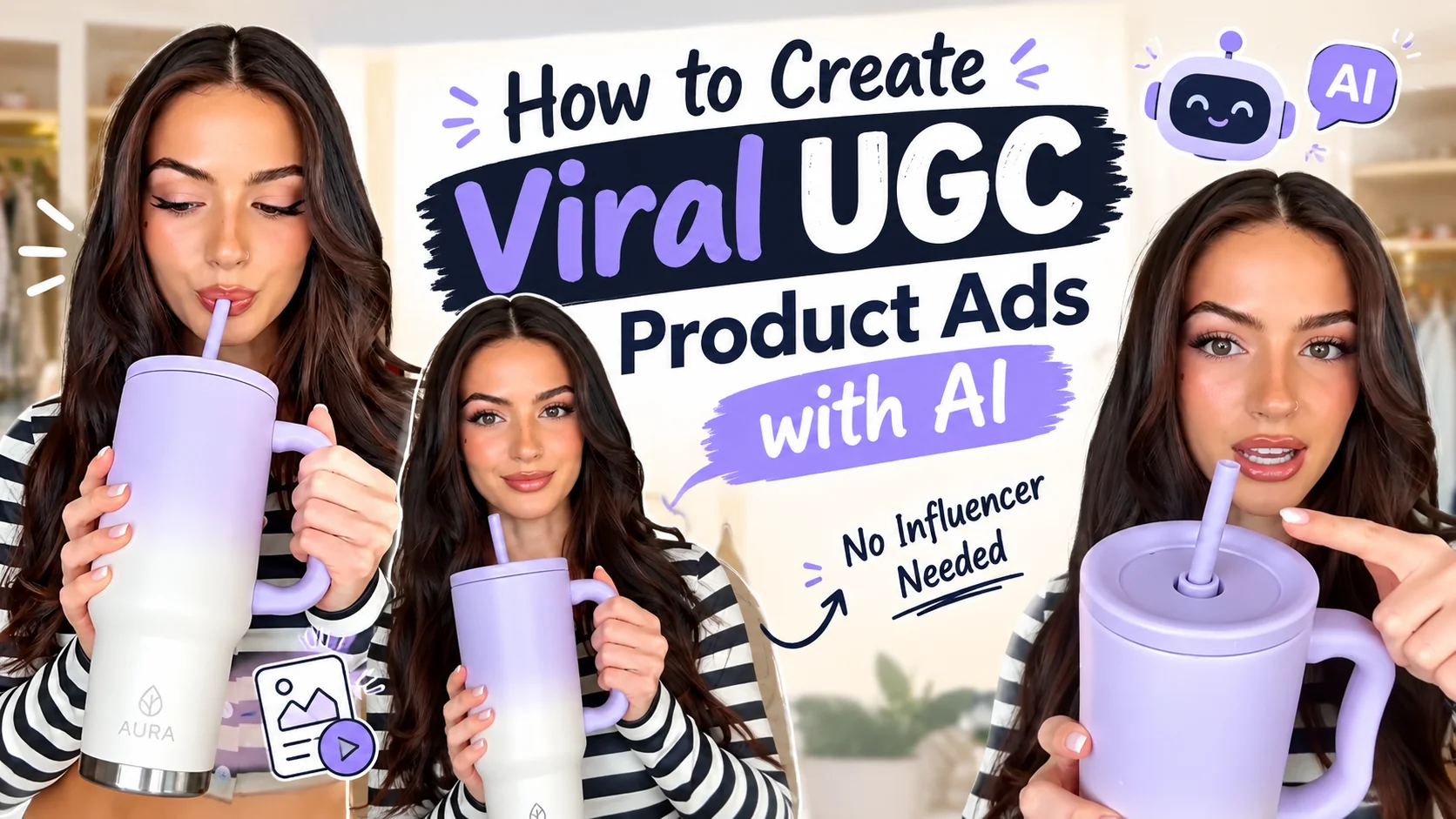
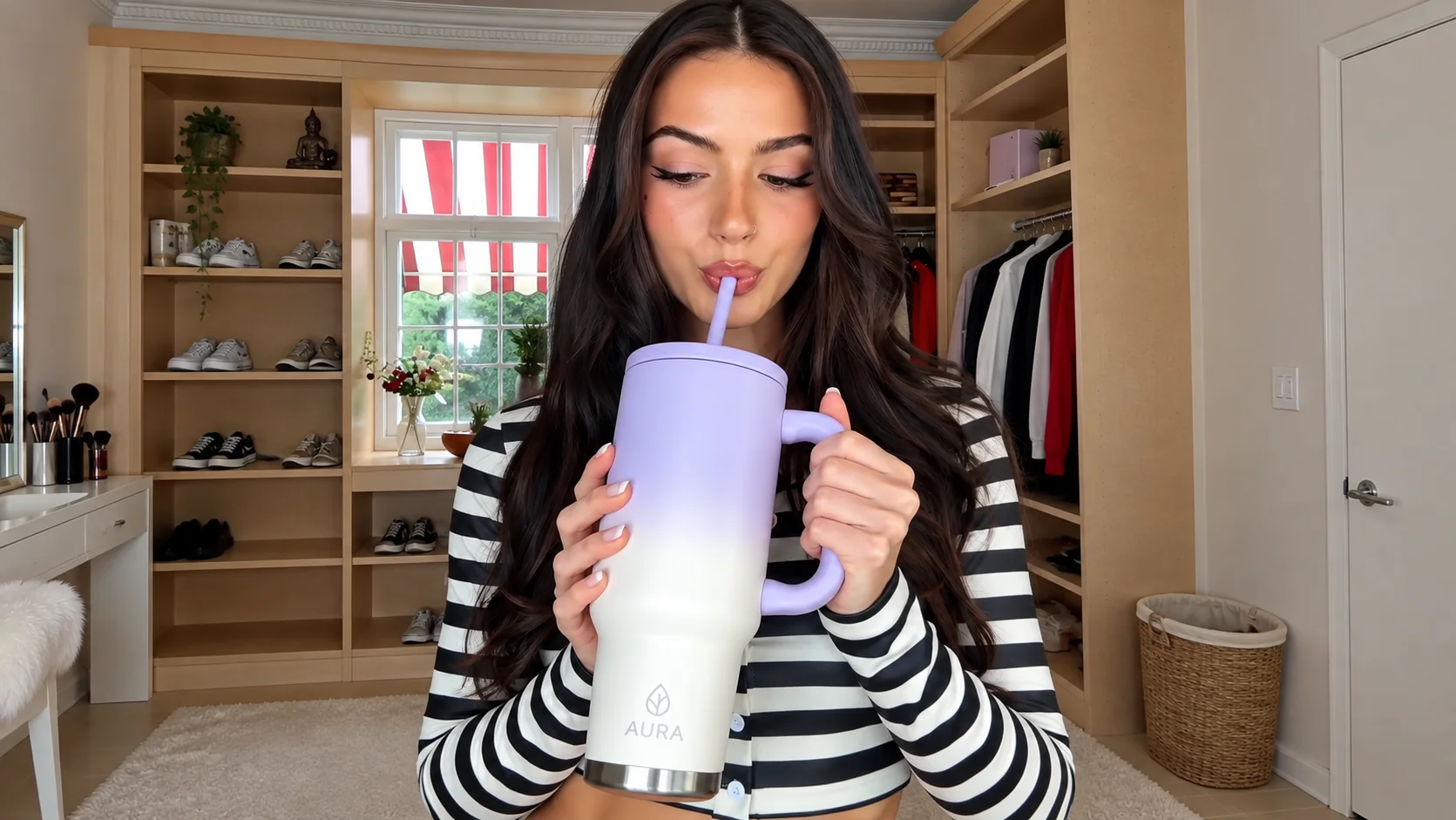
This 15 second ad has every part of a viral product video. A creator talking straight to camera, a product that fills half the frame, a point at the one feature that matters, a sip, and a reaction. There is no influencer behind it. The creator was made with AI, and the whole ad cost about $2.
For years, "viral UGC" meant finding a creator with the right look, paying her, shipping the product, and hoping. Now the look, the delivery and the format can all be built. What cannot be faked is the formula. Viral product ads share a structure, and when you know it, you can make one for any product in an afternoon.
This guide breaks down that formula using the tumbler ad above, with hooks, a script, and the exact AI prompt behind it.
What makes a product ad go viral
Viral is not luck. The product ads that spread on TikTok and Reels almost all share five things:
A face in the first frame. Not a product shot. A person, close to the lens, already talking.
One product, held big. The product fills a third to a half of the frame. The viewer can see it, the colour, the shape, the size against her hand.
One feature, pointed at. Viral ads do not list features. The creator points at one thing and says why it matters.
A use moment. She drinks from it, puts it on, opens it. The product does the thing it is for, on camera.
A reaction, not a pitch. A sip and a look. A nod. An eyebrow. The reaction is the CTA.
Fifteen seconds is enough for all five. The tumbler ad does it in exactly that: talk, hold, point at the straw lid, sip, look at camera.
The 4 shots in a viral UGC product ad
AI UGC creator sipping from a tumbler straw and looking at the camera, reaction shot
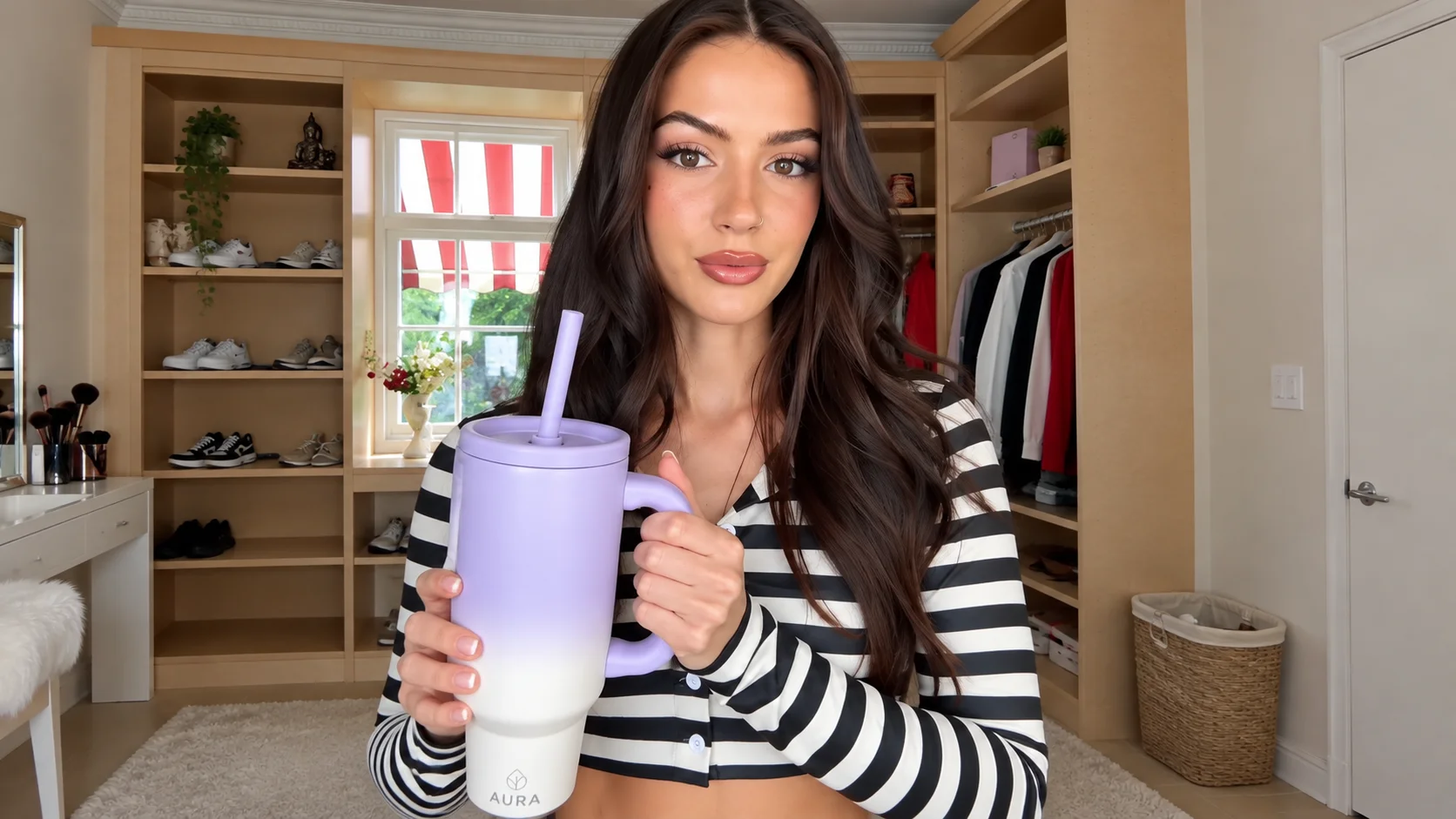
Shot 1: Talking with the product in hand
The ad opens here. Creator close to the lens, tumbler held by the handle at chest height, mouth mid-sentence. The closet behind her with shoes and hangers says "this is her room, not a set".
Rules for this shot: the product is in frame from frame one, held naturally (by the handle, not presented on a palm), and she is already speaking. Viewers decide in under a second whether this is a person or an ad. Talking wins.
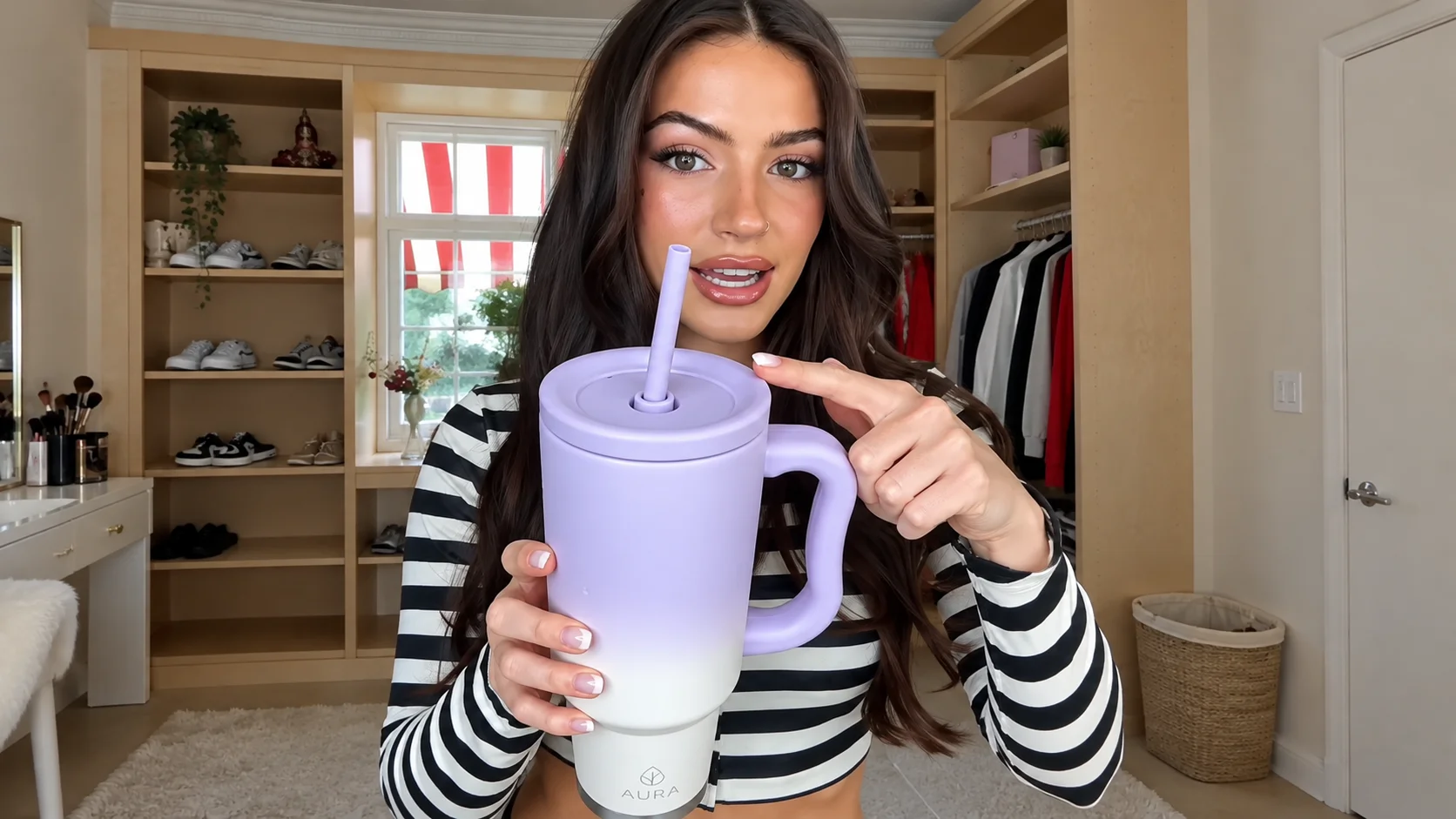
Shot 2: The feature, pointed at
AI UGC creator drinking from a lavender tumbler straw, product use moment in a UGC ad
This is the shot that sells. The tumbler is lifted so it fills the bottom half of the frame, and she points at the straw lid while explaining it. One finger, one feature.
Pick the feature the buyer actually cares about. For a tumbler it is the lid and straw. For a bag it is the pocket. For headphones it is the case. Point at it. Pointing on camera is one of the most shared gestures on TikTok because it tells the viewer where to look.
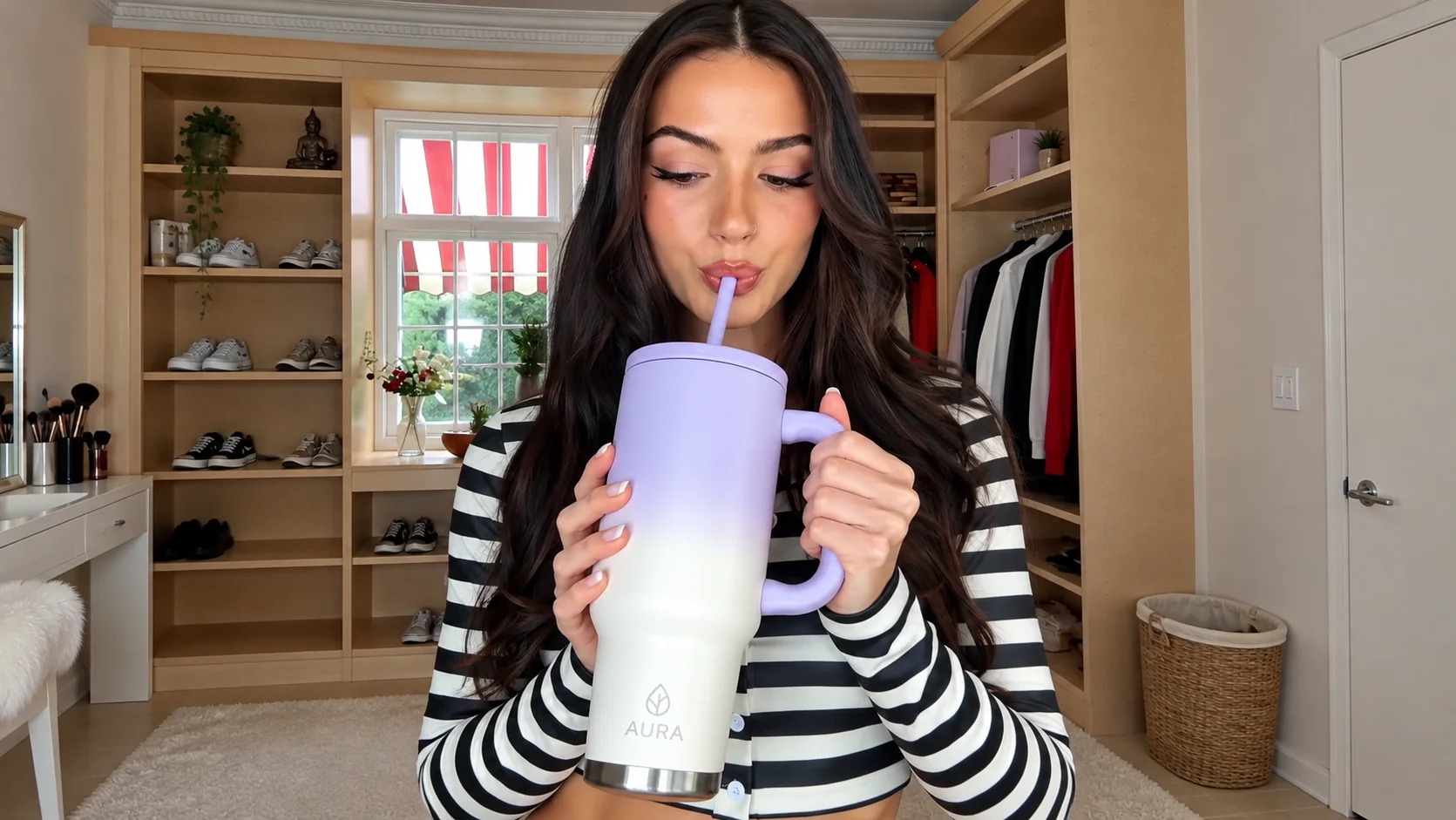
Shot 3: The use moment
AI UGC creator holding a lavender tumbler by the handle while talking to camera
She drinks. Eyes down, lips on the straw, both hands on the cup. Nothing else in the ad proves the product works like this two seconds does. Every viral product ad has a use moment: the sip, the spray, the zip, the click.
Make it slightly imperfect. Eyes down rather than on camera. A small pause before. That is what reads as real.
Shot 4: The reaction
AI UGC creator pointing at the straw lid of a lavender tumbler in a viral product ad
Same sip, but now she looks at the lens. This is the close. No "buy now". A look, a small smile, the ad ends. Viewers share reactions, not pitches, and the reaction is what makes them watch again.
If you only have budget for one still from the ad, make it this one. It works as the thumbnail, the pin, and the first frame of the Reel.
Hooks that make product ads spread
The first two seconds decide whether the use moment ever gets seen. Use one of these, spoken, with the product already in hand.
The "everyone asked" hook. "Everyone keeps asking where this is from, so here."
The replacement hook. "This replaced three things on my desk."
The one-feature hook. "I bought this for the lid. Let me show you why."
The disbelief hook. "I did not think I needed a 40oz cup. I was wrong."
The comparison hook. "Cheaper than the one everyone has, and the handle is better."
The habit hook. "I drink twice as much water now and this is the only reason."
The tumbler ad uses the one-feature hook. One claim, then the point at the lid proves it.
The 15 second script
Viral product ads are short. Fifteen seconds forces one idea. Structure:
0 to 2s: hook. Product in hand, one claim.
2 to 7s: the feature. Point at it, say why it matters in one sentence.
7 to 11s: the use moment. Do the thing. Sip, zip, click.
11 to 15s: reaction. Look at camera, small smile, soft CTA or none.
A script you can copy for any product:
Okay I bought this for the lid and I need to explain.
It has a straw and it seals, so it does not spill in my bag.
Forty ounces, handle, fits in the cup holder.
That's it. That's the whole review.
No brand name in the first line. No feature list. One reason, one demo, done.
How to make a viral UGC product ad with AI
Hiring an influencer for this means finding one with the right look, negotiating, shipping the product, waiting two weeks, and getting one video with usage rights that cost extra. If it does not perform, you start over.
Here is the workflow behind the tumbler ad.
Step 1: The product image. A clean shot of the product with the colour, shape and logo clear. For the tumbler: lavender to cream fade, handle visible, straw in. The model needs to see the handle and the lid to show them being used.
Step 2: The creator. Build one in the UGC character generator or pick one from the Community. For lifestyle products, go for the creator your buyer follows: long dark hair, soft glam makeup, a striped cropped top, a bedroom or closet behind her. The creator in these images is the template. Save the image and reuse it so every ad in the campaign has the same face.
Step 3: The ad. Open the UGC ad generator. Upload the creator as @image1 and the tumbler as @image2. Describe the ad in one box. The prompt used:
@image1 stands close to a phone camera in a bright walk-in closet,
shelves of shoes and hanging clothes out of focus behind her, striped
window awning visible. She holds @image2 by the handle at chest height
and talks to camera: "okay I bought this for the lid and I need to
explain". She lifts the cup so it fills the lower half of the frame and
points at the straw lid with one finger. She takes a sip through the
straw with her eyes down, then looks up at the camera mid-sip with a
small smile. Ends there.
Casual speech with pauses, natural hand movement, product always in
frame. Soft daylight, slightly off centre, handheld feel. Natural skin
texture, no beauty smoothing, no studio lighting, no fast cuts.
Settings: 9:16, 720P, 15s, sound effect on. Run two or three attempts and keep the one where the sip and the look feel real.
Step 4: Variations. Same creator, same product, three hooks. Use the UGC video generator for the clips between ads (a "what's in my bag", a desk setup) so the face shows up in organic content too. Use the UGC image generator for stills: the reaction shot as a thumbnail, the pointing shot for a carousel.
Cost per finished ad: around $2 across three attempts. An influencer for the same video: $300 to $1500 plus product plus usage rights plus two weeks.
Mistakes that stop product ads going viral
Opening on the product. Open on the face. The product is in hand, but she is the first thing seen.
Listing features. One feature, pointed at. The rest goes in the caption.
No use moment. Holding is not using. Sip, zip, click, spray.
A pitch at the end. "Link in bio, use my code" kills the share. End on the reaction.
Studio background. A closet, a kitchen, a car. Real rooms get shared, sets do not.
A creator who does not match the buyer. The face should look like the person who would buy it.
Over 20 seconds. Viral product ads are 10 to 15 seconds. Longer is a review, not an ad.
Where to run viral UGC product ads
TikTok and Reels organic. This is where the format lives. Post the ad as-is, hook as on-screen text, no caption pitch.
Meta and TikTok paid. Same ad, three hooks, let the platform pick. Refresh the hook every two weeks; product ads fatigue fast.
Product pages. The 15 second clip next to add-to-cart. The use moment answers "what is it actually like" before the viewer scrolls to reviews.
Pinterest. The reaction shot as a video pin with the hook as the title.
FAQ
Can you make a viral UGC ad without an influencer? Yes. What makes a product ad spread is the formula, not the person: a face in the first frame, one product held big, one feature pointed at, a use moment, and a reaction. An AI creator can deliver all five, and you keep the same face across every ad.
How long should a viral UGC product ad be? Ten to fifteen seconds. Long enough for a hook, one feature, a use moment and a reaction. Over twenty seconds it becomes a review, and reviews get watched but rarely shared.
What makes a product ad go viral on TikTok? A person talking in the first frame, a product the viewer can clearly see, one specific feature instead of a list, the product being used on camera, and an ending that is a reaction rather than a pitch. Real rooms and natural skin help more than editing.
How do I make UGC product ads with AI? Use a clean product image and a creator built to match your buyer. Describe the ad in one prompt: what she says, where she points, how she uses the product, and how she reacts. Keep the product in frame the whole time and ask for natural skin texture. The tumbler ad in this guide was made this way.
How much does an AI UGC product ad cost compared to an influencer? Around $2 per finished ad with AI, across two or three attempts, with no shipping and no usage-rights fees. An influencer for a single product video runs $300 to $1500 plus the product, plus extra for ad usage rights, plus two weeks of turnaround.

Komal Yousaf
Komal Yousaf covers design and marketing at Templix, bridging creative tooling with growth strategy to help brands turn AI-generated content into real results.